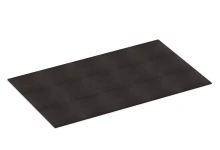
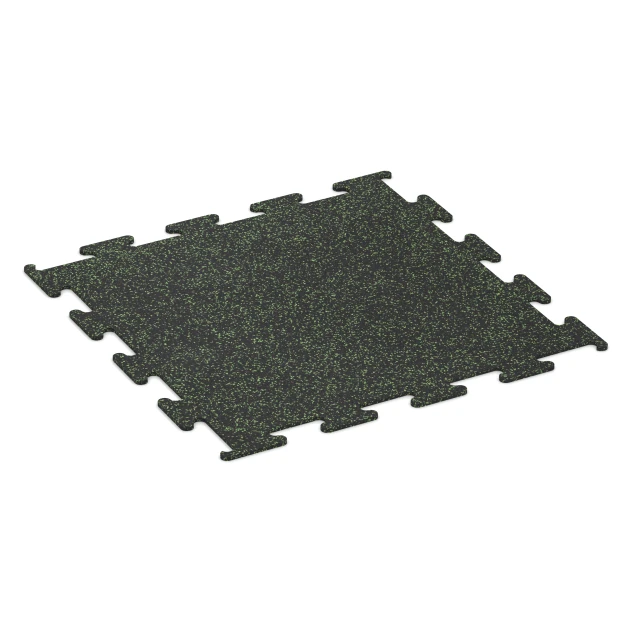
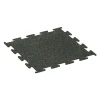
Fitness Performance Elite Training Floor DZ "Lightly speckled green"
- /
-
Ready to ship
in approx. 7-14 days - £28.30 / 1 Piece / m²
- (10.00 kg / Piece)
EAN: 4251469337558 | Item no.: 3755
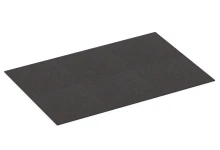
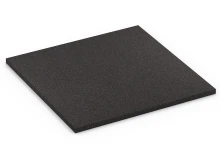
Fitness Performance Elite Training Floor is intended for indoor training areas where reliable grip and a consistent surface are required. Manufactured from PU-bound rubber granulate, the tiles are produced oversized and calibrated after curing. This ensures accurate dimensions and a flat upper surface. The result is a uniform installation with a clean, even appearance and dependable performance across connected areas, including frequent reconfiguration.
Manufacture and material
The material consists of rubber granulate bound with polyurethane to form dense, resilient tiles. By cutting after curing rather than casting to final size, each element maintains tight tolerances. This method provides consistent thickness and clean edges, supporting an even layout and uniform load distribution across the surface.
Surface and performance
The flat, closed surface provides slip resistance suited to dynamic movement such as strength training, functional circuits and free weights. Abrasion resistance supports ongoing use with equipment, while the material structure absorbs vibration and reduces impact sound. This contributes to a quieter training space and helps limit noise transfer to adjacent areas.
Installation system
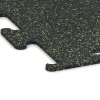
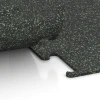
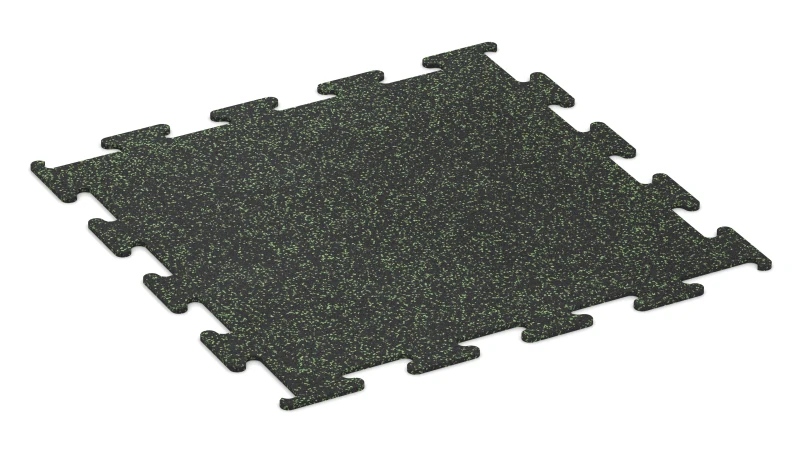
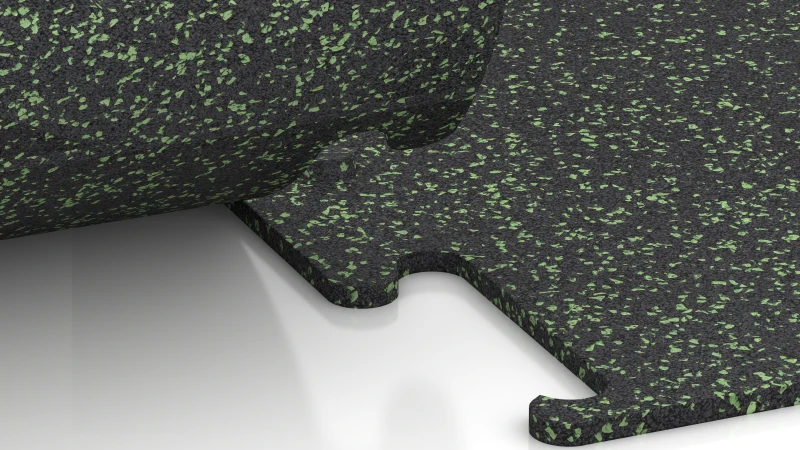
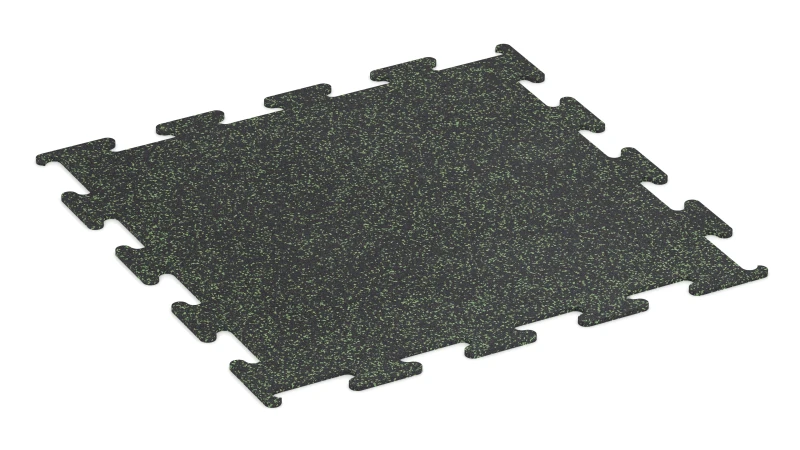
Each tile features a precision-cut puzzle joint without bevel. The edges interlock cleanly, creating a near-continuous surface with minimal visible joints. Tiles are loose-laid without adhesive. This allows straightforward placement, adjustment and removal if the layout needs to be changed or extended. The two available tile formats do not interlock with each other, so a single format is used throughout each continuous area.
System accessories
For perimeter detailing and transitions, the system includes the edge ramp art. 4165, which creates a defined and accessible finish at open edges. Where additional build-up height or further damping is required, the functional tile XX can be used as an underlay beneath the top layer, extending the system’s application range within the same installation concept.


Discount
Product Highlights
Characteristics
Product Details – Material and Structure
Comparative values
Impact-absorbing flooring made from PU-bound rubber granules reduces impact sound and the structure-borne sound it generates. The elastic floor covering absorbs impacts and reduces their transfer to the substrate.
Impact sound occurs when walking, jumping, moving furniture or setting down weights cause a floor or storey slab to vibrate. These vibrations travel through solid building components as structure-borne sound and can become audible as airborne sound in other rooms.
Structure-borne sound can also be caused by machinery and by installations fixed to the building. It may have causes and transmission paths other than impact sound, so it cannot be reduced by a floor covering alone.
Under load, a floor covering made from rubber granules deforms elastically. This deformation transfers the load to the substrate less abruptly, reduces the peak force and, through the covering’s internal damping, further weakens the remaining vibrations.
Sound-insulation tiles reduce excitation of the substrate from footsteps, jumps and impacting objects. Where higher requirements apply, multi-layer flooring systems with functional layers of differing elasticity can further reduce impact transmission. Their effectiveness depends on the properties of each layer, the load applied, and the existing floor or slab structure.
The number of tiles required for an irregular area can be calculated manually or determined using the digital laying planner.
For irregular areas, a scaled laying plan on graph paper is recommended. For the manual calculation method, draw the area on graph paper at a scale of 1:100, where 1 cm corresponds to 1 m. Place the tile grid over the drawing and draw the tiles within the area according to their laying dimensions. The drawing shows where offcuts will be required and allows the required number of tiles to be counted.
The online laying planner determines the quantity required more quickly than the manual calculation method. It is available for every product in the online shop. Once the area dimensions have been entered, the tool automatically calculates the number of tiles required and displays a suitable laying pattern. On the product page, simply click ‘Plan installation’. The planner works directly in the browser, is free of charge and does not require registration.
Installation of many WARCO rubber tiles can be carried out without a specialist contractor.
WARCO rubber tiles can be used as flooring for patios and balconies, as fitness flooring and as playground safety surfacing. This requires the product, substrate and build-up to be appropriate for the intended application.
The tiles are loose-laid. Depending on the range, they are joined using a puzzle-style interlock or plastic connectors.
Preparation of the substrate and any necessary edge cutting can be managed with practical DIY skills.
Pri večslojni sestavi gumijastih plošč lahko nosilnost, blaženje in skupno višino prilagodimo posamezni vrsti uporabe. Vrhnja pohodna plošča serije XT je vidna površina talne obloge in določa njeno odpornost proti obrabi. Pod njo je ena ali več podložnih plošč tipa XX.
Gumijasti granulat, vezan s poliuretanom, je material, iz katerega so izdelane tako pohodne plošče serije XT kot podložne plošče tipa XX. Obe vrsti sta na voljo v različnih debelinah in gostotah. Z izbiro in kombiniranjem obeh vrst plošč višino sestave, nosilnost in blaženje prilagodimo načinu uporabe. Zato lahko sestavi enake višine zagotavljata različno stopnjo blaženja.
Pri sestavi, prilagojeni blaženju udarcev, se na igriščih poveča kritična višina padca. Pri vadbi z utežmi takšna sestava prevzame del energije udarca. V notranjih prostorih bolje duši udarni zvok in zmanjša prenos zvoka skozi konstrukcijo, pod stroji in napravami ter na območjih, občutljivih na tresljaje, pa izboljša dušenje vibracij.
Unter eine Hantelablage kommt eine tragfähige Gummiplatte ab 2 cm Stärke oder ein zweilagiger Aufbau mit einer Funktionsplatte der Klasse 1 als Basis.
Bei einer Hantelablage steht die Tragfähigkeit im Vordergrund. Die dauerhafte Last wirkt über wenige Auflagepunkte als Punktlast auf den Bodenbelag. Beim Absetzen oder Fallen einer Hantel entsteht dagegen kurzzeitig eine Stoßlast auf kleiner Fläche. Der Bodenaufbau soll die dauerhafte Last tragen, ohne zu stark nachzugeben. Zugleich soll er den Stoß dämpfen und die Übertragung von Schwingungen und Körperschall in den Untergrund mindern.
Für einen einlagigen Bodenaufbau ist eine tragfähige Gummiplatte mit mindestens 2 cm Stärke erforderlich. Ein Beispiel ist der Fitness Performance Impact Trainingsboden in 3 cm Stärke. Gummiplatten mit 1 oder 1,5 cm Stärke reichen für die dauerhafte Last einer Hantelablage nicht aus.
Bei einem mehrlagigen Bodenaufbau können die einzelnen Schichten unterschiedliche Dichten und Funktionen haben. Die Funktionsplatte der Klasse 1 bildet die tragfähige Basis und ist nur für den Innenbereich vorgesehen. Darüber bildet eine Belagplatte oder ein fester Fitnessboden wie der Fitness Performance Elite Trainingsboden die sichtbare Nutzschicht. Durch die Auswahl und Kombination der Schichten lassen sich Tragfähigkeit und Dämpfungswirkung auf den Einsatzort und die Nutzung abstimmen.
Različne vrste gumenih plošč lahko polagamo v več plasteh eno na drugo. Funkcijske plošče tipa XX so na voljo v treh razredih blaženja. Pod zaključno ploščo jih lahko kombiniramo v poljubnem številu plasti in vrstnem redu, posamezne funkcijske plasti pa se lahko med seboj razlikujejo po razredu blaženja, gostoti in debelini.
Sestav zaključuje plošča tipa XT ali druga zaključna plošča, ki se lahko od funkcijskih plošč razlikuje po gostoti in elastičnosti. Vrstni red plasti izberemo glede na namen površine in želeni učinek. Z izbiro in razporeditvijo plasti lahko uskladimo blaženje udarcev, nosilnost in porazdelitev točkovnih obremenitev. Enako debeli sestavi se tako lahko razlikujejo po nosilnosti, elastičnosti in blaženju.
Pri polaganju gumijastih plošč v več plasteh fuge zamaknemo, da v zgornji plasti niso neposredno nad fugami v spodnji. Plošče vsake naslednje plasti so zamaknjene glede na plošče pod njimi in prekrivajo fuge spodnje plasti.
Tako fuge ne potekajo neprekinjeno skozi celotno oblogo, kar pripomore k enakomerni površini. Na prostem zamik obenem prekine možnost, da bi rastline iz podlage skozi fuge prerasle vse plasti.
Bei einem mehrschichtigen Bodenaufbau, also einem Sandwichsystem, wird bei abgenutzter Oberfläche meist nur die obere Belagplatte erneuert. Die darunterliegenden Funktionsplatten haben in der Regel eine deutlich längere Lebensdauer und müssen deshalb erst viel später ausgetauscht werden.
Abnutzung und Abrieb betreffen vor allem die Nutzschicht, auf der gegangen, trainiert oder gespielt wird. Direkte Sonneneinstrahlung und Abrieb an der Oberfläche erreichen die Funktionsplatten darunter nicht. Deshalb können sie meistens weiterverwendet werden.
Weil nur die Belagplatte ausgetauscht wird, fallen die Kosten deutlich geringer aus als bei einer vollständigen Erneuerung des Bodenbelags. Beim Austausch kann eine Belagplatte in einer anderen Farbe eingesetzt werden. So ist ein Farbwechsel möglich, ohne den gesamten Bodenbelag neu verlegen zu müssen.
Obložne in funkcijske plošče različnih mer lahko v talnem sestavu polagamo v več slojih, niso pa zasnovane tako, da bi se pri polaganju natančno pokrivale.
Pokrivna mera obložne plošče, torej mera, ki jo plošča pokrije v položenem stanju brez fug, znaša 44,6 × 44,6 cm oziroma 97,1 × 97,1 cm. Funkcijska plošča ima format 52 × 52 cm oziroma 104 × 104 cm. Polaga se brez zaskočnega spoja, na tesen stik; njena pokrivna mera je zato enaka formatu plošče.
Ker sta rastra polaganja različna, so fuge obeh slojev med seboj zamaknjene, kar je tudi predvideno: fuge tako ne potekajo skozi oba sloja v isti liniji.
Potrebno količino izračunamo za vsak sloj posebej. Površina, ki jo oblagamo, je pri obeh slojih enaka, število plošč pa je odvisno od pokrivne mere plošč v posameznem sloju.