
Base Layer CL 1 XX "Anthracite"
- /
-
Ready to ship
in approx. 3-4 weeks – production yet to start - £42.55 / 0.93 Piece / m²
- (27.74 kg / Piece)
EAN: 4251469366589 | Item no.: 6658
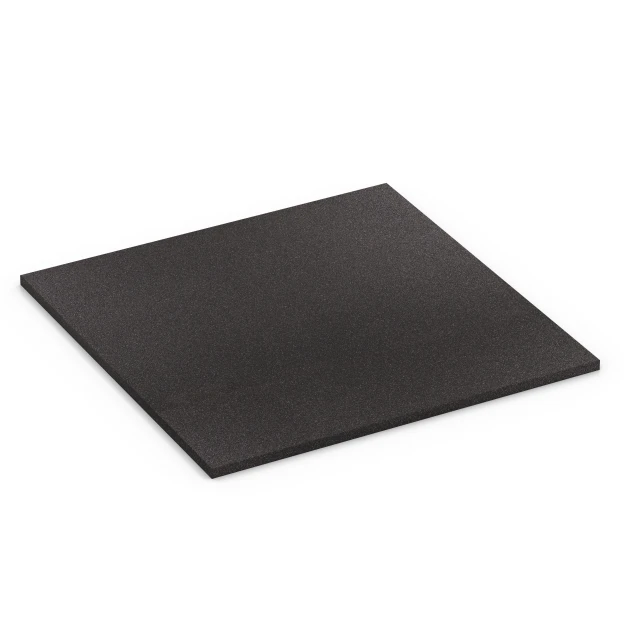
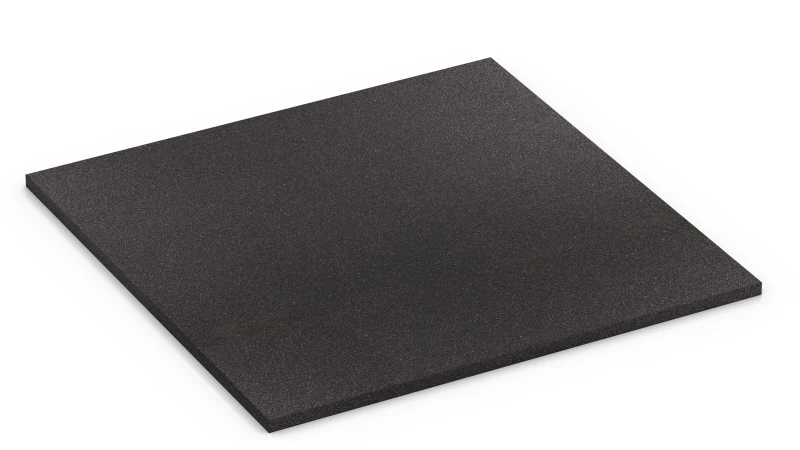
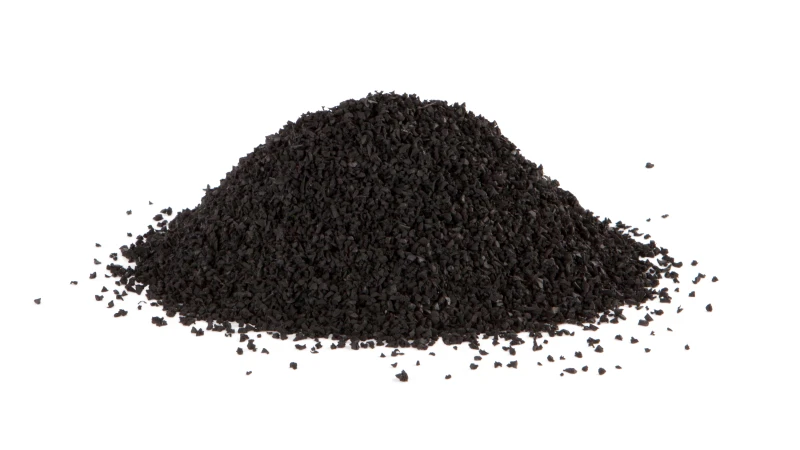
Base Layer CL 1 is a dense elastic underlay made from PU-bound rubber granules, developed for multi-layer floor constructions where load-bearing capacity and vibration control are the primary requirements. It is installed beneath a top layer tile and is intended for indoor use, for example in areas with concentrated loads, equipment or repetitive movement. The compact structure provides a stable base while still contributing to impact reduction.
Load-bearing performance
Class 1 represents the firmest variant within the damping range. The high material density ensures limited deformation under load and reliable support for point loads and equipment. At the same time, the material structure absorbs part of the impact energy and reduces vibration transmission into the subfloor. This balance is relevant in applications where structural stability and controlled damping are required.
Build-up height
The total build-up height depends on the selected top layer tile and the number of base layers. A single layer results in a low system height, while additional layers increase the elastic response. Thicknesses are specified in cm and can be adapted to suit installation conditions, interfaces and technical requirements.
Combination of classes
Base layers from different damping classes can be combined within one system. Class 1 can be used in zones with higher loads, while softer layers from higher classes may be integrated in adjacent areas if additional cushioning is required. This allows targeted adjustment of performance without changing the visible surface.
Staggered installation
In multi-layer constructions, the tiles are laid with staggered joints. Joints in one layer do not align with those in the next, supporting a more even distribution of loads. Installation is carried out as a floating system without permanent fixing to the subfloor.
Advantages of sandwich construction
In a sandwich construction, the top layer tile and the base layers work together. The top layer defines the surface characteristics and use, while the base layers provide structural support and vibration damping. The same surface can therefore be combined with different system properties. The construction can be modified later by adding or removing layers.
System thicknesses
The following configurations illustrate typical combinations of top layer tile and UL:
1.8 – top layer tile 1.8
2.8 – top layer tile 2.8
3.6 – top layer tile 1.8 + UL 1.8
4.6 – top layer tile 2.8 + UL 1.8
5.4 – top layer tile 1.8 + UL 1.8 + UL 1.8
5.6 – top layer tile 2.8 + UL 2.8
6.4 – top layer tile 1.8 + UL 2.8 + UL 1.8
7.2 – top layer tile 1.8 + UL 1.8 + UL 1.8 + UL 1.8
7.4 – top layer tile 1.8 + UL 2.8 + UL 2.8
8.2 – top layer tile 1.8 + UL 2.8 + UL 1.8 + UL 1.8
8.4 – top layer tile 2.8 + UL 2.8 + UL 2.8
9.2 – top layer tile 1.8 + UL 2.8 + UL 2.8 + UL 1.8
10.2 – top layer tile 1.8 + UL 2.8 + UL 2.8 + UL 2.8
11.2 – top layer tile 2.8 + UL 2.8 + UL 2.8 + UL 2.8
Base Layer CL 1 is not intended as a visible surface but as a structural component within the system. When correctly specified, it contributes to a stable, resilient and vibration-reducing floor build-up for indoor applications.


Discount
Product Highlights
Characteristics
Product Details – Material and Structure


Comparative values
A rubber tile’s class indicates how much cushioning it provides underfoot and how much weight it can support: class 1 supports the most weight, class 3 provides the most cushioning, and class 2 falls between them on both counts. The more cushioning a tile provides, the more it gives under load.
Class 1 gives the least under load because it has the highest load-bearing capacity and provides the least cushioning. It spreads heavy loads applied at a single point across its surface and reduces vibration. It is for indoor use only.
Class 2 can be used indoors or outdoors. It has moderate load-bearing capacity and cushioning, offering a balance of support and give underfoot. It is typically laid beneath patio and balcony coverings or paving slabs, and in entrance areas.
Class 3 has the lowest load-bearing capacity and provides the most cushioning. It gives the most under load and absorbs the most impact energy, so it is suitable where a springy surface and noise reduction are needed. It can be used indoors or outdoors. All three classes are available in two sizes, 52 × 52 cm and 104 × 104 cm, and two thicknesses, 1.8 cm and 2.8 cm.
Different rubber tiles can be combined in a layered system. Type XX tiles are available in three cushioning grades; any number can be used in any order beneath the surface tile. Each of these layers can have its own cushioning grade, density and thickness. The visible surface is formed by a type XT surface tile or another surface tile, whose density and elasticity need not match those of the tiles beneath it.
The order of the layers depends on how the area will be used and the performance required of the layered system. The layers are selected and arranged to balance shock absorption, load-bearing capacity and how point loads are spread. Two systems of the same overall height can therefore differ in load-bearing capacity, elasticity and damping.
Where rubber tiles are laid in more than one layer, the joints in each layer should be staggered rather than positioned directly above one another. In a multi-layer build-up, each layer is offset from the one below so that the tiles in the upper layer bridge the joints in the layer beneath.
Staggering the joints in this way avoids joint lines running straight through the build-up and helps to keep the finished surface even. Outdoors, it also leaves no continuous path for vegetation to grow up from the ground beneath.
Different tile sizes can be combined in a floor with more than one layer. Surface tiles and functional tiles are designed to be used together in this way, rather than stacked with their joints aligned.
Allowing for joints, each surface tile occupies 44.6 × 44.6 cm or 97.1 × 97.1 cm. Functional tiles, by contrast, come in 52 × 52 cm or 104 × 104 cm sizes and are laid with butt joints, without interlocking edges. Their nominal dimensions are therefore also the dimensions used to calculate coverage.
The layers are laid to different grids so that their joints are offset as intended. Joints in the upper and lower layers never align to form a continuous joint through the floor.
The number of tiles must therefore be calculated separately for each layer. The floor area to be covered is the same for both, but the number of tiles required depends on the coverage dimensions of each tile type.
Im Freien können Funktionsplatten der Klassen 2 und 3 unter einem Bodenbelag aus Gummiplatten verwendet werden. Klasse 1 ist nur für den Innenbereich vorgesehen.
Die Klasse bestimmt, wie tragfähig und wie stark dämpfend der Bodenaufbau ist. Klasse 2 verbindet Tragfähigkeit mit Trittelastizität. Sie ist die übliche Wahl unter Terrassenbelägen, Balkonbelägen und Wegplatten sowie in Eingangsbereichen. Klasse 3 kommt dort zum Einsatz, wo vor allem Stoßdämpfung gefragt ist, etwa unter einem Spielplatzbelag.
Beide Funktionsplatten bestehen aus ELT-Gummigranulat. Sie sind frostbeständig und flächig wasserdurchlässig. An der Unterseite befinden sich quadratische Auflagepads mit breiten, flachen Drainagekanälen. Dadurch kann Regenwasser auf wasserundurchlässigen Untergründen unter dem Bodenbelag ablaufen, statt sich im Aufbau zu stauen.
Im System XT ist der Bodenaufbau mindestens 1,8 cm hoch. Eine feste Maximalhöhe gibt es nicht, weil die Zahl der übereinanderliegenden Platten nicht begrenzt ist.
Oben liegt immer eine Belagplatte vom Typ XT. Ohne Funktionsplatte ist der Bodenaufbau einlagig. Mit einer oder mehreren Funktionsplatten vom Typ XX darunter entsteht ein mehrlagiger Sandwichaufbau. Belagplatten und Funktionsplatten sind jeweils 1,8 oder 2,8 cm dick. Funktionsplatten beider Dicken lassen sich in beliebiger Zahl miteinander kombinieren.
Die Aufbauhöhe ergibt sich aus der Summe aller Plattendicken. Durch die Kombination von 1,8 und 2,8 cm entstehen fein abgestufte Aufbauhöhen. Auch bei gleicher Aufbauhöhe sind verschiedene Plattenkombinationen möglich. Sie können sich in Tragfähigkeit und Dämpfung unterscheiden. Welche Kombination passt, richtet sich nach dem Einsatzzweck.
Bei einem mehrschichtigen Bodenaufbau, also einem Sandwichsystem, wird bei abgenutzter Oberfläche meist nur die obere Belagplatte erneuert. Die darunterliegenden Funktionsplatten haben in der Regel eine deutlich längere Lebensdauer und müssen deshalb erst viel später ausgetauscht werden.
Abnutzung und Abrieb betreffen vor allem die Nutzschicht, auf der gegangen, trainiert oder gespielt wird. Direkte Sonneneinstrahlung und Abrieb an der Oberfläche erreichen die Funktionsplatten darunter nicht. Deshalb können sie meistens weiterverwendet werden.
Weil nur die Belagplatte ausgetauscht wird, fallen die Kosten deutlich geringer aus als bei einer vollständigen Erneuerung des Bodenbelags. Beim Austausch kann eine Belagplatte in einer anderen Farbe eingesetzt werden. So ist ein Farbwechsel möglich, ohne den gesamten Bodenbelag neu verlegen zu müssen.