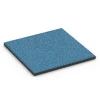
Rubber patio tile Classic FP "Atlantic"
- /
-
Ready to ship
from stock in 1-3 days - £74.40 / 4 Piece / m²
- (5.42 kg / Piece)
EAN: 4251469363618 | Item no.: 6361
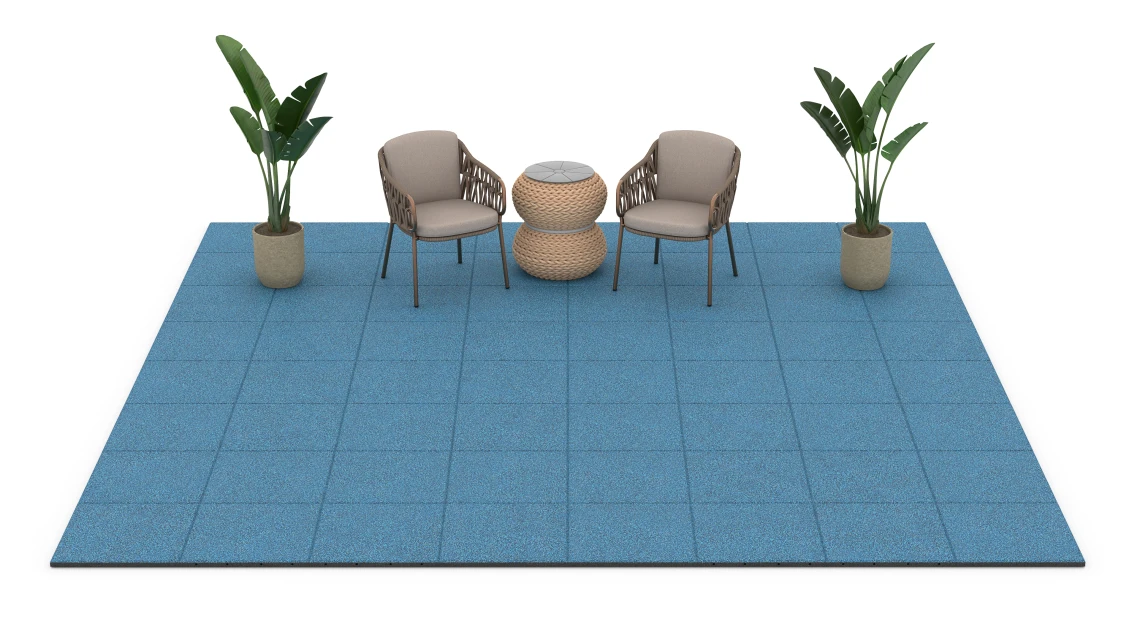
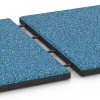
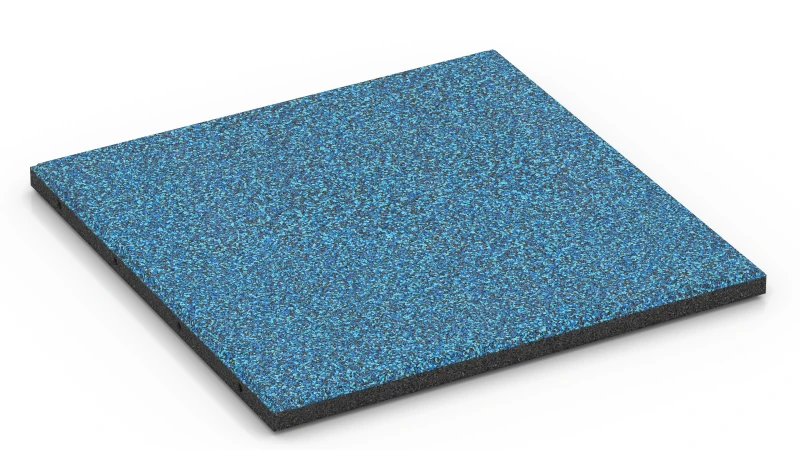
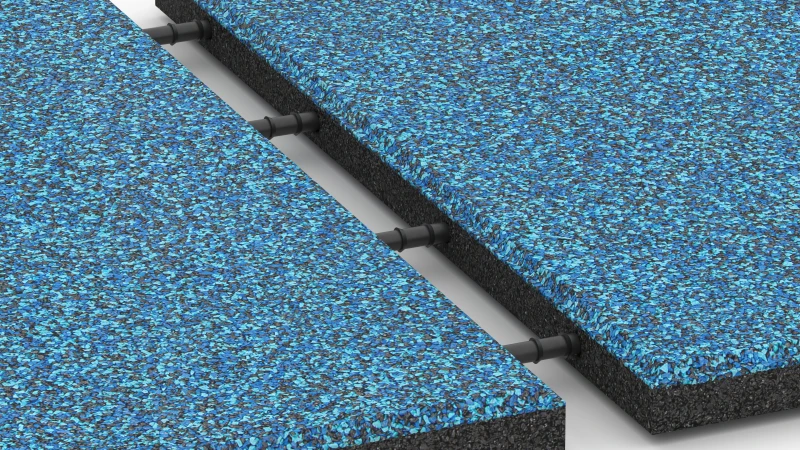
Rubber patio tile Classic is a permeable tile for balconies, terraces, roof terraces and loggias. It is laid loose in a staggered bond and linked with plastic connector pins through pre-drilled side holes, so each tile connects with four neighbours. The result is a stable, serviceable surface that can be lifted locally if access below is needed or an individual tile has to be replaced.
Dual-layer construction
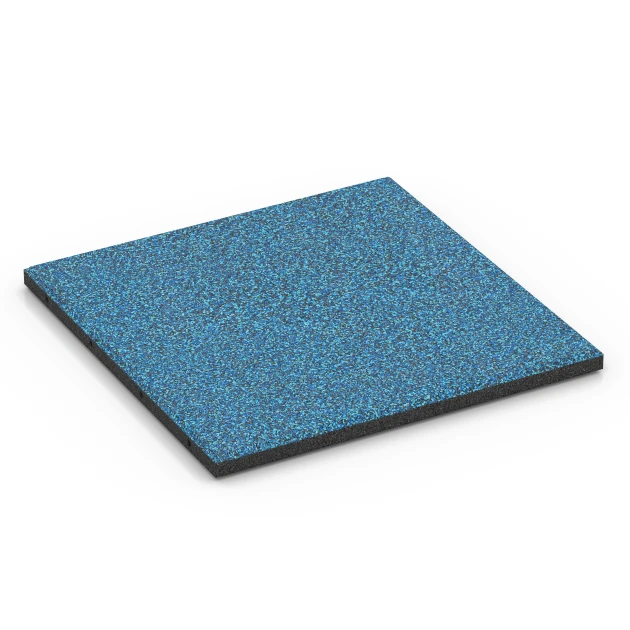
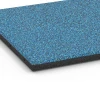
The tile has a dual-layer construction. Its carrier layer is made from PU-bound ELT granulate from recycled end-of-life tyres, while the wear layer is made from freshly manufactured EPDM granulate. Because the EPDM layer is through-coloured and UV-resistant, the surface keeps a consistent appearance outdoors and provides a finer, more even finish than a single-layer tile.
Installation and connection
The tiles are installed on solid substrates such as concrete or asphalt, and on plastic gravel grids. In staggered layouts, perimeter edging is used to reduce lateral movement along the outside rows; this edging can be omitted only where the connector pins are additionally fixed with permanently elastic PU adhesive. The four-neighbour pin connection keeps adjoining rows aligned, and where extra restraint is needed the pins themselves can also be bonded.
Drainage and substrate behaviour
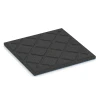
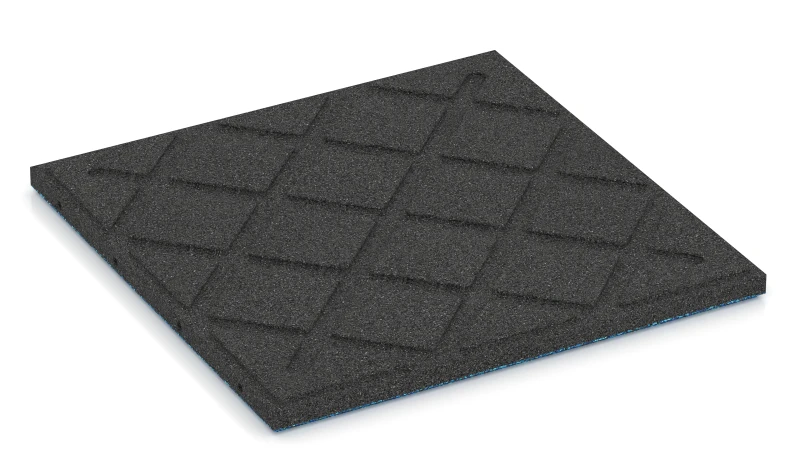
The open-pored structure allows rainwater to pass through the tile. On solid substrates, underside drainage channels direct water along the existing fall towards the outlet. When laid over plastic gravel grids, water drains through the tile and infiltrates below, so the surface remains free-draining without trapping standing water above the construction.
Surface and comfort underfoot
The EPDM wear layer creates a fine, grippy surface that is comfortable under bare feet and dependable in both wet and dry conditions. The elastic structure softens footfall, dampens rolling noise and gives the floor a more forgiving feel than hard exterior finishes. That suits family areas where children play, floor exercises take place or outdoor seating is used regularly.
Weather resistance and maintenance
The tile is frost-resistant and weather-resistant, making it suitable for year-round outdoor use. Day-to-day care is straightforward, and because the surface is not fixed across the whole area, individual tiles can be exchanged without taking up the complete installation.


Discount
Product Highlights
Characteristics
Product Details – Material and Structure
Comparative values
Ethylene propylene diene monomer rubber, abbreviated to EPDM, is a synthetic rubber made from ethylene, propylene and a small proportion of diene. EPDM rubber granules are produced by crushing a vulcanised rubber compound based on EPDM and are used chiefly for coloured, weather-resistant surfaces.
For these surfaces, the diene content provides sites at which the polymer chains crosslink during vulcanisation, forming an elastic network. The composition and degree of crosslinking determine hardness, elasticity, resistance to heat and cold, and chemical resistance. EPDM has a largely saturated main chain and offers high resistance to ozone, UV radiation and ageing. It remains elastic in cold conditions and is resistant to water, dilute acids and dilute alkalis. Mineral oils and fuels can cause EPDM to swell.
Alongside these material properties, the coloured EPDM rubber granules used by WARCO are newly manufactured. Colour is incorporated into the rubber compound, so each granule is coloured throughout its cross-section.
The through-coloured EPDM rubber granules form the coloured wearing layer of two-layer patio tiles, balcony tiles, fitness tiles and safety surfacing tiles. An elastic backing layer of PU-bound ELT rubber granules sits beneath the EPDM wearing layer.
Patio tiles made from PU-bound rubber granules change over time in colour and surface appearance, while their elastic properties change more slowly. The extent of these changes depends on the type of granules, sunlight at the installation site and the use of the area. Patio tiles pass through a bedding-in phase during the first few weeks. With coloured recycled tyre rubber granules (ELT), the pigmented PU binder initially becomes slightly darker in sunlight; because individual patio tiles receive differing amounts of light, the surface can temporarily appear uneven. A freshly cut EPDM wearing layer may take on a slightly warmer tone during its first days in sunlight.
In sunlight, a patio tile may temporarily become darker because of the PU binder rather than the EPDM rubber granules. This change is reversible: the colour subsequently becomes lighter again and the appearance will generally even out. With UV-stabilised tiles, UV radiation affects the tile more slowly; this does not refer to colour shade and is not a promise that the colour will remain unchanged.
Over the longer term, the colour appearance changes for different reasons depending on the type of granules. Natural black ELT rubber granules are deep black when new, gradually developing an anthracite tone under UV exposure, similar to the colour change seen in car tyres. In coloured ELT, the PU binder is pigmented and forms a coloured coating around the black rubber granules. The colour is held in this coating rather than in the granules themselves, so use on walked-on areas can abrade the coating and reveal the black rubber granules beneath. An EPDM wearing layer is coloured throughout, colour-stable and UV-resistant.
Deposits can also alter the appearance. Dust, pollen and fine sand can settle in the surface structure, making the area appear duller; these residues can be removed, while the slip-resistant properties remain. This should be distinguished from the long-term behaviour of pure ELT under sustained intense sunlight: it slowly loses elasticity and becomes more brittle near the surface, a process that develops more slowly than visible colour changes.
Patio tiles made from rubber granules achieve slip resistance class R10 under BS EN 16165. The test uses standard test footwear on an oil-wetted ramp, in accordance with Annex B of BS EN 16165 (formerly DIN 51130). Depending on the product range, the mean overall acceptance angle lies between 12 and 17 degrees, so every range achieves R10. The tiles are described as slip-resistant rather than slip-proof because the classification applies only to the conditions tested.
Most of this slip resistance comes from hysteresis friction: the sole of the shoe deforms as it moulds around the individual rubber granules, and it is that deformation that generates most of the friction. Outdoors in rain, the permeable surface also helps, as rainwater drains through the tiles and a continuous film of water does not normally build up. The oil ramp test does not capture this effect.
The tiles have not been rated for barefoot areas under Annex A of BS EN 16165 (classes A, B or C), so no slip resistance rating can be given for barefoot use. Wet leaves, algae, ice, frost, compacted snow, oil, grease and cleaning residues can reduce slip resistance or remove it altogether. Keep the surface clear, sweep it and remove any oil promptly. Slip resistance may also decline over the service life, as abrasion can gradually smooth the surface of the granules.
How thick patio tiles are depends on the type of covering, the installation method and how the area will be used. Typical thicknesses vary considerably between patio coverings.
Ceramic patio tiles are usually around 0.8–1.2 cm thick and are fully bonded to the substrate. Ceramic slabs laid on pedestals without adhesive are generally around 2 cm thick.
Natural stone slabs are commonly 3–5 cm thick, depending on the type of stone and the slab format. Concrete patio slabs are typically 4–6 cm thick, with larger formats sometimes requiring greater thickness.
Timber and WPC decking boards are generally around 2–3 cm thick and are fixed to a supporting frame. Thinner boards require closer spacing between supports. Interlocking timber or plastic tiles with a backing grid are available from around 1.5 cm.
Patio tiles made from PU-bound rubber granules are available in thicknesses of around 2–4 cm, depending on the range. They are loose laid and usually joined by an integrated interlocking system to form a continuous surface.
Which patio surface heats up least in the sun depends more on sun exposure and surface colour than on the material itself. A shaded patio remains coolest; trees, awnings or a shade sail keep direct sunlight off the surface, while air movement supports surface cooling.
In direct sun, light-coloured surfaces heat up less than dark ones. Light surfaces reflect a greater proportion of solar radiation, whereas dark surfaces absorb more radiation and convert it into heat. This applies to wood, WPC, stone, ceramic and rubber granules.
Alongside surface temperature, the material affects how hot a patio surface feels underfoot. Dense stone, ceramic or concrete surfaces transfer stored heat to the sole of the foot quickly. Patio tiles made from PU-bound rubber granules have a porous grain structure and low density, transferring less heat to the skin during brief contact and cooling down quickly once direct sunlight has ended.
Ceramic patio slabs with dense surfaces and water-permeable patio slabs made from rubber granules bound with polyurethane are both easy to maintain. How often they need cleaning depends on their surface texture, the joints, the patio’s location and how well it drains.
Dirt tends to sit on the surface of ceramic patio slabs and can usually be swept or washed away. Rough or heavily textured surfaces and wide joints, however, trap dirt more readily and need more upkeep. This is particularly true of exposed aggregate slabs, but also applies to natural stone, terracotta and timber deck tiles.
Patio slabs made from rubber granules work differently: rainwater carries fine dust and pollen through their water-permeable structure. Leaves, soil and sand can be removed with a broom or garden hose. A pressure washer can be used for a more thorough clean, with the water draining through the slabs.
Being easy to maintain does not make patio slabs maintenance-free. Dirt and vegetation need to be cleared regularly from drainage outlets, edges and open joints.
WARCO rubber patio tiles start at around €36 (about £31) per square metre. At that price, the tiles are 3 cm thick and measure 50 × 50 cm, so four tiles cover one square metre. All prices include VAT.
The cost of patio slabs varies by product range, thickness and surface. Slabs with a coloured EPDM surface are among the more expensive options, at up to around €110 (about £94) per square metre. You can find the price of each option on its product page in the online shop.
The price per square metre is for the tiles alone. On a firm base such as concrete, asphalt, concrete block paving or natural stone paving slabs, the tiles can be laid loose without mortar or adhesive (dry-laid), making installation a DIY job. If there is no firm base, you also need to allow for the cost of a sub-base, such as one built from gravel grids.
Patio tiles made from rubber granules require an edge restraint where lateral movement is possible. Where the tiles are firmly connected to each other, an edge restraint may be omitted. The same applies where the tiles are permanently bonded to the substrate.
Existing lateral boundaries can replace an additional edge restraint. If a wall, balustrade, parapet or kerb adjoins the edge tiles directly, no further restraint is needed. No further restraint is needed where a lawn meets the edge tiles flush and at the same level.
Turf rooted in the ground provides lateral support for the tiles and prevents them from shifting. Bonded tiles generally do not require an edge restraint. Designs with a fixed puzzle interlock generally do not require an edge restraint.
The formation beneath patio slabs must be level, have adequate load-bearing capacity and be well drained. For ground-level patios, the substrate must be built to withstand frost. The precise construction depends on the type of patio slab and the existing site conditions.
For a ground-level patio, the sub-base comprises a formation with adequate load-bearing capacity and adequately compacted frost-protection and load-bearing layers. Rigid concrete or natural stone slabs are normally laid on an evenly screeded laying course of chippings. Depending on the system, ceramic patio slabs may be installed on a laying course of chippings, on adjustable pedestals or in a bonded system. Timber and WPC decking require a suitable substructure.
Patio tiles made from PU-bound rubber granules require continuous support and cannot be supported at individual points on adjustable pedestals. On sound concrete, asphalt, concrete block paving or natural stone, PU-bound rubber granule tiles can be loose-laid without a mortar bed. The existing substrate must allow water to drain at an adequate fall towards an outlet or infiltration area.
On an unpaved substrate, first create a level formation with adequate load-bearing capacity. A gravel grid laid across the full area can provide stable, water-permeable support on this formation. Fill the gravel grid cells completely with suitable chippings. Depending on substrate conditions and frost exposure, a compacted frost-protection and load-bearing layer beneath the gravel grid may also be required. A concrete slab is not required for a gravel-grid construction.
Gravel stabilisation grids can be installed as a sub-base in three ways: directly on in-situ ground, on a grit laying course over the formation, or on a crushed-stone sub-base.
The grid cells are filled with crushed, angular grit. The cells are filled to the top, and the grit is levelled flush with their upper edges.
Where the ground has sufficient bearing capacity and is only lightly loaded, installation directly on in-situ ground is sufficient. Topsoil must first be removed, and the formation must be carefully prepared. The grids are laid directly on the natural ground, allowing the 4 cm ground spikes to penetrate the soil.
A thin grit layer can be laid over the formation to even out irregularities. The ground spikes extend through this grit layer and into the formation.
Where the ground has a low bearing capacity, protection from frost effects is required, or high loads are expected, a crushed-stone sub-base must first be installed and compacted. The ground spikes cannot penetrate the compacted crushed stone. A grit layer is therefore laid over the sub-base so that the spikes are fully embedded. This grit layer must be at least 6 cm thick, and the grids must sit firmly on it.
Gravel grids are also sold as grass grids or plastic cellular grids. The grids are set into the thin grit layer, which is about 2 to 5 cm thick when used to even out irregularities.
Plastic connectors, also known as connector pins or plastic connecting pins, are cylindrical plastic pins with a profiled surface. They fit into factory drilled holes along the sides of the tiles and connect rubber tiles in adjacent rows. Perpendicular to the connector axis, they prevent the tiles from shifting relative to one another. Along the connector axis, the tiles remain free to move.
The tiles are laid row by row in half bond. The plastic connectors are first inserted into the holes along one side of the tile being positioned. With the connectors leading, this tile is then pressed into the holes in the two adjoining tiles in the row already laid. The connectors are designed to fit tightly, so noticeable force during insertion and when pressing the tiles together is normal. If required, the connectors may be glued in place, which prevents the tiles from drifting apart along the connector axis.
Limescale, chalk efflorescence and stubborn dirt can be removed from rubber tiles with an EPDM surface using a mildly acidic cleaner. The biodegradable Sonett Toilet Cleaner Mint & Myrtle has proved effective for this purpose. Apply the cleaner evenly, leave it to work for 10 to 15 minutes, brush the surface carefully and then rinse thoroughly with clean water.
For routine cleaning, a neutral cleaner is sufficient. Sonett Orange Power Cleaner may be used at the dilution intended for floor cleaning. Larger indoor areas can be cleaned with a scrubber dryer fitted with a cylindrical brush; a single-disc machine is unsuitable.
Do not use strongly alkaline cleaners, abrasive cleaners or unauthorised solvent-based cleaning products. Test every new cleaning product first in an inconspicuous area. Acidic cleaners must not be allowed to dry on the surface.
Good design made easy.