
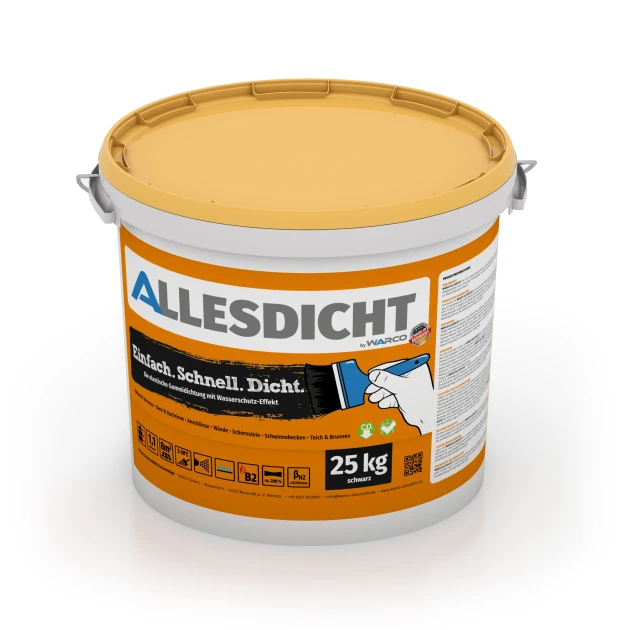
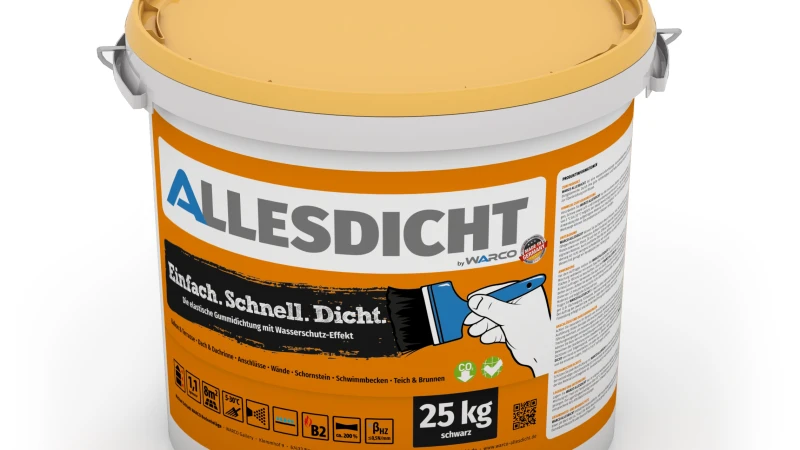
ALLESDICHT – Liquid Rubber Waterproofing AD "Black"
- /
-
Ready to ship
from stock in 1-3 days - £28.93 / 0.13 Piece / m² x 2 mm
- (25.00 kg / Piece)
EAN: 4251469300248 | Item no.: 0024
ALLESDICHT is a ready-to-use, rubber-based liquid-applied waterproofing for balconies, terraces, flat roofs and basements. The material is applied straight from the bucket and dries to form a seamless, elastic rubber membrane. This waterproof coating keeps out water and bridges fine cracks in the substrate.
Where can ALLESDICHT be used?
ALLESDICHT waterproofs horizontal and vertical surfaces indoors and outdoors. Typical uses include waterproofing balconies and terraces, leaking flat roofs and garage roofs, gutters, and basement walls and floor slabs in contact with the ground. Because it is applied as a liquid, ALLESDICHT also waterproofs junctions, transitions between surfaces and pipe penetrations without seams.
What surfaces does the liquid waterproofing adhere to?
ALLESDICHT adheres to almost all sound substrates, including concrete, bitumen, brick, wood, metal, fibre cement, tiles and firmly bonded old coatings. The waterproofing remains firmly bonded to the substrate even if moisture comes through from behind. The dried rubber membrane can stretch by around 200% and bridges cracks up to 0.5 mm.
Is ALLESDICHT an alternative to resin-based membranes?
ALLESDICHT is as easy to apply as a resin-based liquid waterproofing membrane, but it is a water-thinnable dispersion containing finely ground rubber from used tyres. The waterproofing is solvent-free and ready to use. No mixing is needed. ALLESDICHT has a honey-like consistency and can be applied with a paintbrush, roofing brush, smoothing trowel or airless sprayer. Tools can be cleaned with water. Apply at 5 to 30 °C in dry weather.
How much ALLESDICHT is needed per m²?
The amount of ALLESDICHT needed depends on the layer thickness. For a dry layer of 1 mm, apply around 1.6 kg per m². The minimum thickness of 2 mm requires around 3.3 kg per m². For structural waterproofing in accordance with the test certificate, the dry layer must be at least 3 mm thick. Apply it in at least three coats. This requires around 4.8 kg per m². Where the building element is exposed to more water, the layer must be 4 mm thick and requires around 6.4 kg per m². Each wet coat must be no more than 1.5 mm thick and must dry before the next coat is applied.
How has ALLESDICHT been tested?
ALLESDICHT has been tested in Germany as structural waterproofing and has a German general building authority test certificate. The waterproofing is impermeable to water, weather-resistant and, when applied correctly, also withstands water under pressure. Its fire behaviour is class B2 under DIN 4102-1. ALLESDICHT can be left exposed as the finished coating. Rubber paving slabs for balconies and terraces can also be laid on the dried waterproofing.


Discount
Product Highlights
Characteristics
Product Details – Material and Structure

Comparative values
The choice between liquid-applied waterproofing and EPDM membranes depends on water exposure, the substrate, and the shape and layout of the area. Both methods are established for refurbishing balconies, terraces, roof areas and basements.
For liquid-applied waterproofing, a ready-to-use ALLESDICHT waterproofing coating is applied in several coats directly to a prepared, load-bearing substrate. Once dry, it forms a crack-bridging ALLESDICHT rubber membrane that seals junctions, corners and penetrations without seams or shaped components.
EPDM membranes are large-format sheets made from synthetic rubber and cut to size. Depending on the construction, they may be laid loose with ballast, mechanically fixed or bonded. A single sheet cut to size can cover wide areas without seams, while junctions and penetrations may require carefully executed bonding or shaped components, depending on the system.
Liquid-applied waterproofing is usually the more practical choice for small and medium-sized areas with numerous detail junctions. For large roof areas with few details, an EPDM roof membrane is usually more practical. Both methods require a load-bearing, clean substrate, and sufficient falls help surface water to drain away.
Waterproofing a terrace involves applying ALLESDICHT liquid-applied waterproofing beneath the terrace covering. The substrate must be sound and clean, while the terrace waterproofing protects the building structure below from penetrating water over the long term. Adequate falls must be provided to ensure water drainage.
ALLESDICHT is applied directly to the prepared substrate. Suitable substrates include concrete, screed, existing tiles and bitumen. It also provides seamless waterproofing at junctions with the house wall, door threshold and drains, which are often weak points in sheet waterproofing.
ALLESDICHT is applied in at least three coats. The test certificate requires a dry film thickness of at least 3 mm; where water exposure is greater, for example due to temporary ponding, a dry film thickness of 4 mm is required. The elastic waterproofing bridges cracks in the substrate up to 0.5 mm wide. Once fully cured, rubber slabs or tiles can be laid directly as the terrace covering, and a further coating can be applied directly.
A tiled balcony can be waterproofed with ALLESDICHT liquid-applied waterproofing without removing the existing tiles; concrete and screed are also suitable substrates. The substrate must be clean, dry and sound. The fall towards the drain must already be correct before waterproofing, as liquid-applied waterproofing follows the existing surface profile and cannot compensate for insufficient fall.
Because of their exposed position and connection to the building, balconies are particularly susceptible to moisture damage. Temperature-related building movement can cause cracks in concrete and damage wall junctions. Water can penetrate through these defects. The elastic ALLESDICHT rubber membrane follows movement in the substrate and bridges cracks up to 0.5 mm wide. At the house wall, the waterproofing is continued seamlessly upwards; railing fixings and the drain are integrated into the waterproofing, with a fabric reinforcement providing additional stability at these transitions.
At the free edge, edging incorporating a drip edge directs water away in a controlled manner. ALLESDICHT is applied in several coats. The required dry-film thickness and the detailing of connections depend on the application instructions for the relevant balcony build-up.
Flat roof waterproofing can be carried out using ALLESDICHT liquid-applied waterproofing applied in at least three coats. A seamless, permanently elastic surface that resists ponded water is essential, as rainwater does not drain as freely from a flat roof as it does from a pitched roof. It collects in depressions and around junctions, where leaks develop first.
The substrate must be clean, dry and sound; suitable substrates include concrete, bitumen, sheet metal and plastic. The liquid-applied waterproofing can be brushed or rolled on, and on large surfaces it can also be applied by airless spraying. Once dry, it forms a seamless rubber membrane that bridges cracks, accommodates movement in the substrate and remains watertight under ponded water.
Roof outlets, rooflights, roof edge terminations, and pipe and cable penetrations are subject to particularly high stresses and require special attention. At these points, the waterproofing is reinforced with an embedded fabric layer. Where an existing flat roof has isolated damaged areas, localised reworking with ALLESDICHT is often sufficient, without a complete replacement of the roof waterproofing system.
A basement can be waterproofed after construction with ALLESDICHT liquid-applied waterproofing. Waterproofing can be carried out externally or internally; the appropriate approach depends on the level of water exposure and access to the basement wall. External waterproofing is the more reliable option because it intercepts water on the water-facing side of the wall. The wall is excavated, the substrate is cleaned and prepared to provide a sound surface, and ALLESDICHT is applied in several coats. Once dry, it forms a seamless, crack-bridging rubber membrane that adheres to concrete, masonry and bitumen and bridges fine settlement cracks.
At the junction between the wall and the base slab and around penetrations, mesh reinforcement is incorporated into the waterproofing. The required dry-film thickness depends on the level of water exposure: around 3 mm is sufficient for ground moisture, while approximately 4 mm is required where water accumulates or is under pressure.
Where the external side is inaccessible, for example because of adjoining structures or walkways, internal waterproofing can be considered. Applied on the side away from the water, it is particularly suitable for ground moisture and non-pressurised water where the substrate and level of exposure permit. The requirements for internal waterproofing are substantially higher where water is under pressure, so the waterproofing design must be assessed for the relevant water load before work begins.
Whichever method is used, the design must account for the relevant water load, and thorough substrate preparation is essential. Loose plaster, efflorescence and contamination must be completely removed before application. The waterproofed surface can then be plastered or clad.
WARCO ALLESDICHT is applied in dry weather. Both air and substrate temperatures must be at least 5 °C and no higher than 30 °C. The liquid-applied waterproofing spreads most evenly between 15 °C and 25 °C. It must not be applied when frost, rain or snow is expected, and the surface must be free from rainwater, dew and condensation. The actual substrate temperature is decisive because dark sheet metal and bituminous surfaces can become considerably warmer than the air in direct sunlight.
These limits reflect how the rubber membrane forms. As the coating dries, water evaporates and the binder particles coalesce to form a continuous, elastic film. Low temperatures and high humidity slow this process, while frost can permanently damage a layer that has not dried through. On very hot substrates, however, the top of the coating may dry faster than the layer beneath, causing a closed film to form prematurely.
A fresh layer remains vulnerable while wet. Dew and high humidity interfere with film formation, and rain can wash uncured coating from the surface. The area must therefore remain free from condensation throughout application and drying. This is particularly important during overnight cooling, as moisture condenses on the fresh coating if the substrate temperature falls below the dew point. Strong wind is also unsuitable because it dries the surface unevenly and carries dust onto it.
A further layer is applied only after film formation in the preceding layer is complete and no coating comes away when touched. The surface is rain-fast after 8 hours of drying, although more time is needed in cool or humid weather. At upstands and penetrations, the construction must be protected from external influences for at least 48 hours while it dries. In cooler seasons, there may be only a narrow window between the morning dew drying and the return of evening moisture.
Depending on the area, liquid rubber can be applied to a prepared substrate by painting, brushing, trowelling or spraying; spraying requires airless spray equipment. The liquid-applied waterproofing is ready to use and only needs to be stirred thoroughly before application. It adheres to almost all common construction substrates, including concrete, wood, bitumen, tiles and metal. The substrate must be sound, clean and dry, and free from dust, oil and grease; highly absorbent areas should first receive a deep-penetrating primer.
The liquid-applied waterproofing is applied in two or three coats, with each subsequent coat applied only after the previous one has fully dried. A wet coat must not exceed 1.5 mm, while the finished rubber membrane reaches a thickness of at least 2 to 3 mm. Additional fabric reinforcement is incorporated at junctions and penetrations. Once dry, the coating forms an elastic, waterproof rubber membrane with elongation of over 200 %, allowing it to accommodate movement in the substrate.
ALLESDICHT liquid-applied waterproofing is applied to the substrate in two, three or more coats, depending on the required coverage. For reliable waterproofing, the dry rubber film must be at least 2 to 3 mm thick.
To achieve this dry thickness, allowance must be made for the loss of about one third of the wet thickness during drying: a 1.5 mm wet coat dries to around 1 mm, so a total wet application of about 3.0 to 4.5 mm is required. Each wet coat must be no more than 1.5 mm thick, and ALLESDICHT is always applied wet-on-dry. The precise number of coats depends on building requirements, the substrate and ambient conditions; additional coats may be appropriate at junctions and penetrations.
Material consumption for ALLESDICHT is approximately 1.6 kg/m² for each millimetre of dry film thickness. A dry film thickness of at least 2 mm is required, so approximately 3.3 kg/m² is needed for a continuous application. Where structural waterproofing is carried out under the applicable test certificate, these minimum values do not apply.
The stated coverage per container is based on a 2 mm dry film thickness: a 3 kg bucket covers approximately 0.9 m², an 11 kg bucket approximately 3.3 m² and a 25 kg bucket approximately 7.6 m². For structural waterproofing, the required dry film thickness depends on the building element’s exposure to water; at least 3 mm or at least 4 mm is specified, depending on that exposure.
At 3 mm dry film thickness, consumption is approximately 4.8 kg/m², while 4 mm requires approximately 6.4 kg/m². A 25 kg bucket covers approximately 5.2 m² at 3 mm and approximately 3.9 m² at 4 mm. Under the applicable test certificate for structural waterproofing, the rubber membrane bridges cracks up to 0.5 mm.
Consumption calculations must distinguish between the wet film and the finished dry film. The fresh material contains water, which evaporates during drying, reducing the film thickness by approximately one third: a 1.5 mm wet coat produces a dry film of about 1 mm. No more than 1.5 mm wet film thickness may be applied in a single coat; at least three coats are required for a 3 mm dry film and at least four coats for a 4 mm dry film.
These consumption figures apply to even, non-porous surfaces. On rough or porous surfaces, at fillets, wall junctions and pipe penetrations, and where fabric reinforcement is used, additional coats are applied by hand. This increases the material requirement and should be included in the quantity take-off in addition to the base area.
A waterproofing layer made with ALLESDICHT remains permanently watertight and reliable for many years when correctly applied. The precise service life of liquid-applied waterproofing depends on site conditions: mechanical loading, UV radiation, temperature changes and the condition of the substrate all affect how quickly the liquid waterproofing membrane ages.
Its longevity depends on the elasticity of the rubber layer. With an elongation of over 200%, it accommodates building movement and thermally induced dimensional changes, bridging fine cracks in the substrate where rigid waterproofing systems frequently fail. The rubber layer also remains watertight under standing water. The specified thickness and a properly prepared substrate are required to achieve the full service life.
ALLESDICHT liquid rubber waterproofing can be painted, plastered or covered with screed once every coat has fully cured.
If plaster or screed is to be applied, this should be taken into account when applying the final coat of the liquid-applied waterproofing. A rough, textured finish is recommended for plaster or screed because it provides better adhesion for the subsequent layer; a smooth finish is sufficient for paint. Curing time depends on coat thickness, temperature and humidity. At room temperature and normal humidity, a 1.5 mm coat is normally fully cured after 24 hours.
A liquid waterproofing compound for bathroom use is non-hazardous, solvent-free and suitable for indoor use. It is water-dilutable and contains no constituents harmful to health. Its main constituent is finely ground rubber powder, bound in a water-based polymer dispersion.
No harmful vapours are generated during application, and the compound can be used for sealing beneath bathroom tiles. Once cured, the rubber membrane is chemically inert and does not release substances into its surroundings; it is suitable for residential and commercial applications.