Outdoor tile TZ "Terracotta"
- /
-
Delivery in approx.
7-14 days - £81.60 / 4 Piece / m²
- (5.78 kg / Piece)
EAN: 4251469326132 | Item no.: 2613
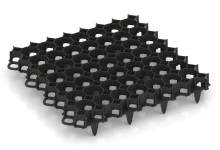
The outdoor tile is a versatile flooring option for almost any exterior space – from balconies and terraces to roof decks, loggias or walkways. It provides a stable, secure and visually attractive surface finish. Available in thicknesses of 3, 4, 5 or 6 cm, the tiles can be perfectly matched to the specific application – from a private seating area to a terrace in a retirement home.
Interlocking edge design with bevel
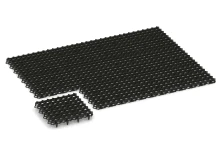
Each tile features a robust interlocking edge design with a subtle bevel. Installation is “floating” – no screwing or gluing required. The interlocking edges fit neatly together, forming a continuous, load-bearing surface that needs no frame or border. If required, the tiles can easily be cut to size using a jigsaw or circular saw.
Comfortable and safe
The elastic rubber material cushions every step and provides joint-friendly walking comfort. Once laid, the flooring feels soft and comfortable underfoot while remaining firm and slip-resistant. Its shock-absorbing and thermal-insulating properties make it especially comfortable and safe – ideal for seniors, children and pets.
Low-maintenance and frost-resistant
The open-pore, water-permeable structure allows rainwater to drain away quickly, keeping the surface dry and slip-resistant even in cold or wet conditions. Dirt can be removed effortlessly with a broom, hose or pressure washer. No sealing or surface treatment required.
Weather-resistant and durable
The advanced rubber material and its flexibility resist cracking or chipping and provide long-term durability. The outdoor tile is frost- and weather-resistant and suitable for year-round use. As with all rubber-granulate flooring, natural ageing may occur over time but has no effect on performance or safety.
With its robust interlocking system, elastic structure and low-maintenance finish, the outdoor tile is a practical and comfortable flooring choice for balconies, terraces, roof decks and other outdoor spaces.


Discount
Product Highlights
Characteristics
Product Details – Material and Structure




Comparative values
To calculate how many tiles you need for your project, simply use the online installation planner available in the shop. This free browser-based tool is directly accessible on each product page – just below the price and quantity selection. Click on “Plan installation” to open the tool instantly – no registration or download required.
Enter the dimensions of your area, such as the length and width in metres. The planner will then automatically calculate the total number of tiles required, including a realistic allowance for offcuts. You’ll also be shown a suitable layout pattern for the selected product. The tool is user-friendly, accurate and ideal for planning your material requirements with confidence.
All WARCO tiles designed for outdoor use are permanently weather-resistant and highly durable. They do not rot, decay or develop mould, and they cannot come loose from the ground, as they are installed without adhesive. Even under frost or intense sunlight, the tiles do not crack or break.
As with wood and other materials, rubber granulate tiles can undergo slight dimensional changes. Due to temperature fluctuations or temporary moisture absorption, the material may expand or contract slightly – a natural effect.
Thanks to their open-pored structure, WARCO tiles are water-permeable. Rainwater can drain evenly through the tiles into the ground, preventing puddles from forming. The water either flows through the integrated drainage structure beneath the tiles or seeps naturally into the soil. This ensures that the surface remains usable even in wet conditions and dries quickly.
WARCO tiles also feature a slip-resistant surface that provides secure footing even when wet. No additional surface treatment is required, as the tiles are low-maintenance, long-lasting and perfectly suited for continuous outdoor use.
Yes, that is the standard approach. The vast majority of our customers – whether private, municipal, or commercial – install the delivered WARCO tiles themselves or with their own staff. The installation is simple and requires no special skills. Only fitting the curb into a concrete foundation with back support demands a little extra craftsmanship. Cutting the elements to size and laying them on a suitable substrate is not challenging. You can find all essential installation information in our Expert Advice – FAQ section on our website.
WARCO offers several connection systems for floor tiles, each differing in design, installation method and visual appearance. Below is an overview of the key differences:
Puzzle joint (visible)
In this system, the tile edges feature an interlocking profile reminiscent of classic jigsaw teeth or mushroom-shaped connectors. During installation, the profiles of adjacent tiles interlock to form a continuous connection across the full tile thickness.
The joint profile may be formed directly during pressing or precisely cut after the tile has cured. Whether the joint is visible in the finished surface depends on the edge finish (e.g. with or without chamfer) and the surface colouration.
The symmetrical shape ensures uniform load transfer and makes this type of joint the most mechanically stable option.
Plug-in connectors (plastic dowels)
This system uses separate connecting elements, typically round plastic dowels, which are inserted into pre-drilled holes along the sides of the tiles. The tiles themselves have smooth, straight edges similar to precast concrete slabs.
Installation is carried out in a half-bond (stretcher bond) pattern: each tile is connected via dowels to two tiles in the row above and two in the row below. This prevents lateral shifting, although some movement along the length of the dowels remains possible. For this reason, an edge restraint must be installed around the perimeter to stabilise the entire area.
Concealed puzzle joint
This method is based on the same mechanical principle as the classic puzzle joint, but is designed to be invisible in the finished surface. The interlocking profile is located on the underside of the tile, integrated into a rebated step joint.
Two tile edges feature a positive locking profile, the other two a matching negative profile. When laid, the tiles interlock securely from below, forming a durable mechanical connection. From above, the surface appears seamless and aligned, typically with a clean, square joint pattern similar to a chessboard layout.
Patio tiles must be installed on a suitable sub-floor to ensure long-term stability and safety. The choice of substrate will depend on the type of decking being used. For tiled decks, a concrete slab is generally required, over which a sloping screed is laid to facilitate proper drainage; the tiles are then glued and grouted.
However, there are variations that do not require a concrete base. For example, rubber granules, wood tiles or thick slabs of concrete or natural stone can be laid on a base of plastic grass grid. This method requires minimal earthwork and offers the advantage of permanent water permeability. When planning your patio, choose the most suitable surface first and then create the appropriate sub-base, avoiding concrete wherever possible.