
Gravel grid WG "Matte Green"
- /
-
Delivery in approx.
1-3 days - £14.16 / 4.42 Piece / m²
- (1.00 kg / Piece)
EAN: 4251469336346 | Item no.: 3634
Plastic ground grids are a versatile and economical solution for stabilising outdoor surfaces. They serve both as an ideal base layer for rubber flooring tiles and as an independent ground reinforcement system for paths, driveways or parking spaces – wherever a long-lasting, load-bearing surface is needed with minimal effort.
Depending on the intended use and expected load, the grids can be installed directly on natural ground, in a compacted gravel bed or over a frost protection layer. The subsequent finish depends on the desired application:
– The grids can be half-filled with soil or substrate and sown with grass, creating a reinforced but natural-looking green surface.
– They can be completely filled with gravel or chippings to create walkways, driveable areas or a base for rubber tiles.
– The surface can be overfilled by approx. 2 cm with decorative gravel, creating a stable and visually appealing gravel driveway or patio.
Installation is straightforward and requires no machinery. Often, it’s sufficient to remove the topsoil, level the base, and embed the grid into a gravel layer. This keeps excavation, material use and labour to a minimum – while still delivering high stability and durability.
WARCO recommends plastic ground grids as a base layer on unbound subsoil – especially where a path, terrace, playground or similar area is to be created on a meadow or natural surface. The result is a solid, permeable and unsealed surface – allowing rainwater to drain naturally into the ground.
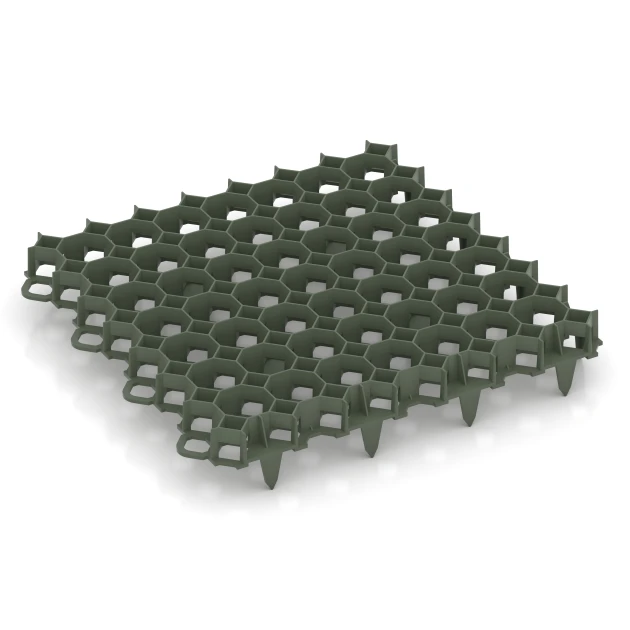
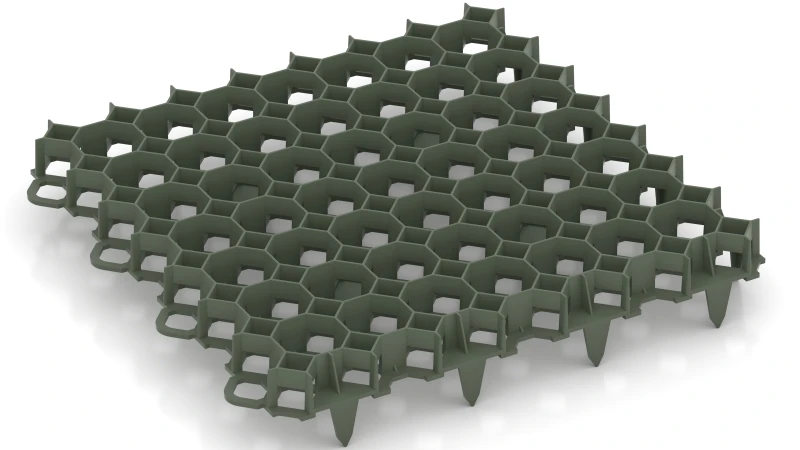
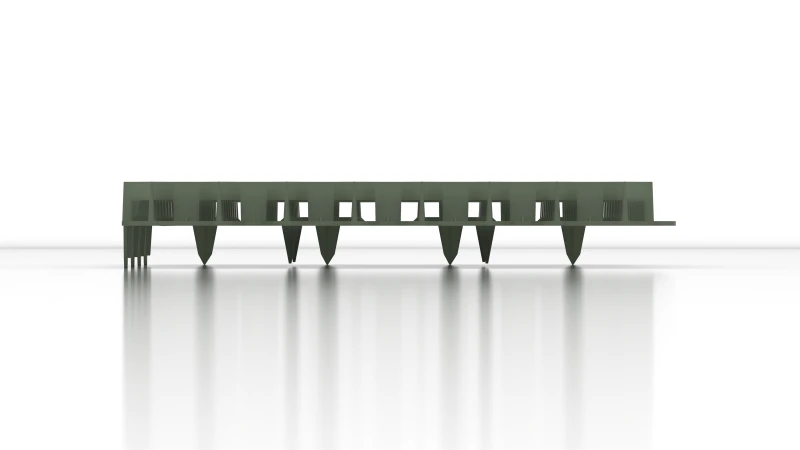
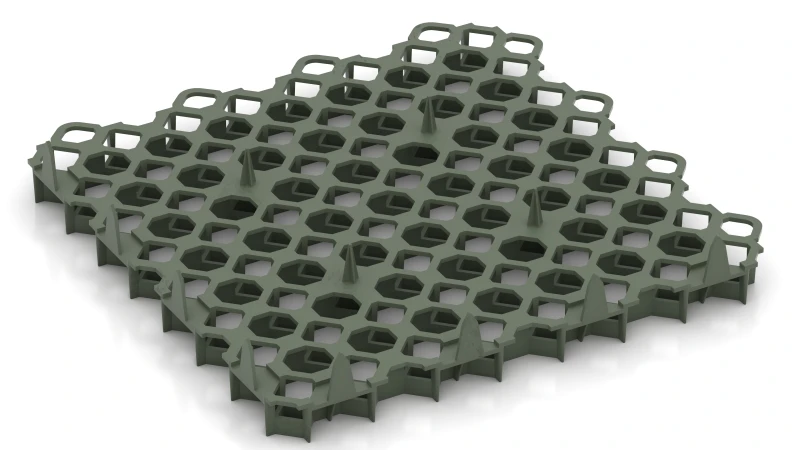
The grid features integrated ground spikes approx. 4 cm in length that actively anchor it into the sub-base. On two sides, interlocking pins engage with matching sockets on neighbouring units to form a secure, load-stable grid system. Once filled with gravel, the surface can withstand loads of up to 400 t/m².
Each unit is made from a single-type plastic regranulate based on PE and PP production offcuts. The material is free from harmful substances, frost-resistant and fully recyclable. Combining both plastics ensures excellent mechanical strength and long service life.



Discount
Product Highlights
Product Details – Material and Structure

Patio slabs may be made from concrete, natural stone, wood, plastic or rubber granules. An even, firm and frost-resistant sub-base is required beneath every type. How much preparation is needed depends on whether the slabs are rigid or elastic and whether the patio already has a hard surface.
Rigid paving slabs made from concrete, natural stone or porcelain are heavy and liable to crack where support is uneven. They are laid on a levelled laying course of grit over a compacted sub-base, fixed with tile adhesive to a concrete base or set on adjustable pedestals. Decking boards and interlocking composite decking tiles are installed on decking joists or adjustable pedestals.
Rubber paving slabs made from PU-bound rubber granules are elastic and do not break. Deflection can occur over individual adjustable pedestals, so continuous support is required. On a patio already surfaced with concrete, asphalt, block paving or natural stone paving, the slabs can be laid loose without a mortar bed, tile adhesive or jointing compound.
If no such hard surface exists, a sub-base of gravel grids, also known as grass grids, is installed beneath the rubber slabs. The cells are filled right to the top with grit. The result is an even, water-permeable support for the patio slabs. No concrete is needed.
Playground safety tiles sit more evenly and remain stable for longer on gravel grids than on a loose grit bed. The honeycomb cells hold the aggregate in place, with the material contained within each individual cell. It can neither move sideways under load nor be washed out during heavy rain, so the tiled surface remains stable and safe over the years.
In a loose grit bed, the particles are broadly the same size and lack the fine material that would fill the voids. Even after compaction, the grit remains mobile. This movement is irrelevant beneath a rigid concrete slab, but an elastic playground safety tile or patio tile made from rubber granules does not spread loads evenly through the substrate. Over time, the grit may be pushed towards the tile edges. The rubber tile then loses support in the centre and sinks there, while displaced grit accumulates beneath the edges and lifts them. This pattern of damage is known as dishing.
Gravel grids are also sold as grass grids, gravel cells or plastic honeycomb grids. They turn a loose grit bed into a stable sub-base. When filling the cells, the aggregate is levelled exactly to the top edge. The contained material stays in place under load and in rain, leaving the tiled surface stable and safe. Filled grids can support up to 400 t/m², while the whole area remains water-permeable. Where the ground is permeable, a gradient and drainage are usually unnecessary.
On load-bearing ground subject to low loads, it is sufficient to remove the topsoil and lay the grids on a thin levelling layer of grit. Less excavation is required than for a conventional construction method. A sub-base of compacted crushed stone is only needed where the ground has limited load-bearing capacity, where the construction needs to be frost-proof, or where the area must carry higher loads. This limited amount of work is an argument in favour of gravel grids.
Gravel stabilisation grids can be installed in three ways, depending on the ground conditions. They may be laid directly on the prepared formation over firm existing ground, set in a bed of angular crushed grit on the formation, or placed above a compacted crushed stone sub-base. In every case, the cells are filled completely with angular crushed grit and struck off flush with the top edges of the grids.
For firm ground subject to light use, the grids are laid directly on the formation. The topsoil is removed and the formation is prepared carefully before the grid units are positioned. Their 4 cm ground spikes penetrate the soil beneath.
Where minor irregularities need to be levelled, a thin bed of angular crushed grit is placed on the formation. This layer should be about 2 to 5 cm deep. The grids are set into the grit so that the ground spikes pass through the layer and enter the soil below.
If the ground is less firm, a frost-resistant build-up is required or heavier use is expected, a crushed stone sub-base is built up and compacted in layers. The ground spikes cannot penetrate the compacted crushed stone. A layer of angular crushed grit at least 6 cm deep is therefore placed over the sub-base, allowing the spikes to be fully embedded in the grit and the grids to be fully bedded.