Event Flooring Podium LZ "Anthracite"
- /
-
Ready to ship
from stock in 1-3 days - £44.80 / 4 Piece / m²
- (5.60 kg / Piece)
EAN: 4251469370562 | Item no.: 7056
Temporary flooring for exhibitions and events has to be installed quickly, removed just as efficiently and reused. This modular event surface is designed for repeated installation in exhibition halls, marquees, temporary structures and open-air venues. It combines a concealed interlocking system with loose-laid installation, making it suitable for sound, load-bearing substrates that are not perfectly prepared.
Quick installation and repeated use
Each tile connects by means of a hidden jigsaw interlock, allowing the surface to be laid without adhesive, screws or clamps. The loose-laid installation can be completed without specialist tools and dismantled just as quickly after the event. Once cleaned, the tiles can be stacked on pallets, transported to the next venue and used again, simplifying logistics for recurring events.
Flexible laying pattern
The concealed interlock remains hidden after installation, creating a tidy and consistent joint pattern across the finished surface. Tiles may be laid in a cross joint arrangement or in a one-third offset pattern, depending on the layout and visual preference. Slightly rounded bevelled edges contribute to a neat appearance while reducing the visibility of the joints.
Comfort underfoot
The resilient rubber granulate surface offers reliable grip for pedestrians while providing a more comfortable walking experience during long events. It helps reduce footfall noise and cushions everyday impacts, making prolonged standing less tiring. Exhibition furniture, display systems and staging equipment benefit from a stable base on the resilient surface.
Indoor and outdoor performance
The flooring can be used inside exhibition halls as well as outdoors for festivals, sporting events, cultural programmes and music venues. Rainwater passes through the porous structure and drains away through the substrate, and the surface dries quickly afterwards, allowing the flooring to be put back into use with minimal interruption in changing weather conditions.
Surface protection and straightforward maintenance
Manufactured from PU bound ELT rubber granules, the resilient covering helps protect the underlying substrate from wear caused by temporary event use. After use it can be cleaned efficiently with a pressure washer or a rotary brush cleaning machine before being stored for the next installation cycle.


Discount
Product Highlights
Characteristics
Product Details – Material and Structure



Comparative values
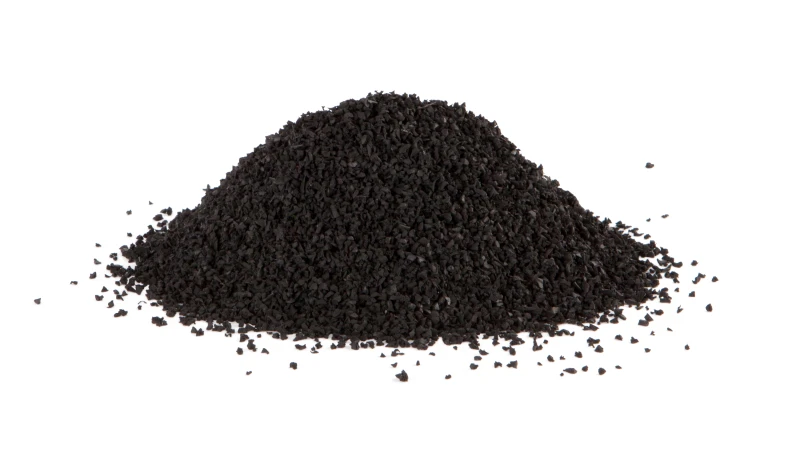
Rubber tiles can be water-permeable at rates ranging from nearly zero to more than 1,100 litres per square metre per hour. Water permeability depends on the particle-size fraction of the rubber granules used and on the pressing pressure applied during manufacture. The tiles are made from PU-bound rubber granules and have an open-pored structure.
Within this porous structure, water does not pass through the rubber itself but through the voids between the bonded granules. The more tightly the granules are compacted, the less water a rubber tile allows through. At low pressing pressure, the irregularly shaped granules sit loosely beside one another, leaving interconnected pores and fine channels through which water flows vertically downwards. An accredited institute measured more than 1,100 litres per square metre per hour in accordance with BS EN 12616, even after four weeks of weathering.
The respective water permeability value is stated as a comparative value in the product description. Rubber tiles made under high pressing pressure have an almost void-free granule structure and allow hardly any water through. A newly laid area absorbs water more slowly during its first days than the measured value may suggest, because the granule surfaces initially resist wetting, much like a new rain jacket. After several days of use, the floor covering reaches its full water permeability; scrubbing it with a little washing-up liquid speeds up this process.
The test report can be submitted to building authorities as evidence of water permeability. How an area is classified depends on the overall system build-up: precipitation can drain through the floor covering into the ground only if the sub-base beneath the rubber tiles also absorbs water.
Rubber flooring for temporary event areas must be selected according to the location, intended use, substrate, load capacity, weather resistance, fire performance and installation method. The floor covering must suit its intended use: areas for standing audiences, catering and exhibition stands have different requirements from temporary sports areas or zones with stages, platforms and trusses. Where wheelchairs, transport trolleys and other wheeled equipment are used, the covering must be sufficiently level and firm for unobstructed movement. In sports areas, elasticity, slip resistance and surface texture must be matched to the sport concerned.
These use requirements also determine the loads to be considered. Furniture, sales stands and technical structures may transfer loads through small contact areas, so the load capacity, deformation behaviour and load distribution of the event floor covering must be checked. Stage, platform and truss feet require suitable spreader plates and a load-bearing substrate. An elastic event floor covering is neither a substitute for a foundation nor for any required structural verification.
A load-bearing substrate does not remove the need to consider comfort: during longer stays, the resilience of an elastic event floor covering can increase comfort for visitors and staff. Fire-performance requirements arise from the applicable regulations and the conditions imposed for the individual event. Escape routes may be subject to stricter requirements than the rest of the event area. For tents, the relevant approval governing their erection applies; for exhibitions, the organiser’s technical regulations apply.
These event-specific requirements also apply where surfaces may become wet. Outdoors and in areas where drinks may be spilled, the surface must be sufficiently slip-resistant when wet. Water-permeable event tiles allow liquid to drain through, but the substrate must then absorb or drain away that liquid.
Once liquid has drained away, the event floor covering must still stay in place. Edges, entrances, cable crossings and transitions must be finished without trip hazards using suitable ramps or edge profiles. A loose-laid event floor covering with an integrated interlocking system can be removed after the event without leaving adhesive residue or drill holes.
Where the substrate is sensitive, a suitable protective layer or separation layer may be required. On grass, the period of use should be kept short, as lack of light, pressure, heat and moisture can damage the turf.
Event flooring that can be laid quickly is a mobile system of modular tiles with an integrated interlocking system. The tiles require neither adhesive nor screws.
Event tiles made from PU-bound rubber granules have puzzle-shaped interlocking edges. During installation, dovetail-shaped teeth mesh together, joining the individual tiles into a continuous surface that stays in place. No subframe or special tools are required to connect the tiles.
After the event, the connections can be released by hand and each tile lifted individually. The floor can be installed or dismantled in sections, allowing several people to work on installation or dismantling at the same time. This modular flooring system is particularly suited to events with tight time windows.
Event flooring for outdoor use must be water-permeable, weather-resistant and slip-resistant.
Rainwater must be able to pass through the covering or, alternatively, run off following the gradient. Without drainage, water remains on the surface and the area does not dry quickly.
WARCO event flooring is made from PU-bound rubber granules and has an open-pored structure that allows rainwater to drain into the substrate. The tiles are UV-resistant and frost-resistant, making them suitable for outdoor events.
The elastic tiles can be laid without a fixed substructure, provided that the substrate is load-bearing and sufficiently level. Suitable substrates include lawn, compacted gravel, paving and asphalt. Unevenness and yielding areas must be levelled before installation.
The tiles cushion footsteps and protect the underlying surface. They are laid without screws or bonding.
The modular event flooring can be removed without damage after the event. It can be cleaned with water and stored in a dry place without taking up much space until its next use.
Reusable alternatives to exhibition carpet include modular exhibition flooring that can be lifted and relaid. Carpet tiles, plastic click and interlocking systems, and click tiles made from rubber granules have become established replacements for single-use carpet on an exhibition stand. Rental systems supplied through a stand builder are also an alternative, as the same flooring area is used by several exhibitors.
These alternatives also differ in the raw materials used. Carpet tiles are available with recycled plastic fibres, while resilient flooring can be made from recycled rubber granules, including recycled tyre rubber granules (ELT) from tyre recycling. For waste prevention, the decisive factor is how often exhibition flooring is used: at ten exhibitions, the same exhibition flooring is used ten times, avoiding waste through repeated use compared with a single-use product made from recycled fibres.
WARCO exhibition flooring consists of click tiles made from PU-bound rubber granules. The base layer is predominantly made from ELT rubber granules, and a colour-fast EPDM wear layer forms the surface. The tiles are installed without adhesive, lifted without damage after the exhibition and relaid at the next venue. They can be used indoors and outdoors; the rubber tiles can be damp-cleaned, and rain and frost do not damage them.
Exhibition flooring can be reused and recycled, although single-use exhibition carpet and tiles made from PU-bound rubber granules differ substantially in their recycling potential. Single-use exhibition carpet is discarded after only a few days at an exhibition. Less than three per cent of carpet waste generated in Europe each year is recycled; the remainder is sent to landfill or incinerated.
Take-back schemes are now available for some certified exhibition carpets. These require the carpet to be clean, dry and free from contamination.
Exhibition flooring made from PU-bound rubber granules follows a different route, beginning with the raw material: ELT rubber granules come from tyre recycling. The tiles are laid loose and can be lifted without tools after the exhibition, cleaned, stacked and stored. Their puzzle interlock retains its shape and fit over many installations, allowing the same tiles to form a continuous surface on changing exhibition stands without creating waste during dismantling. At the end of their service life, used tiles can be shredded and recycled into secondary granulate where regional collection routes are available; otherwise, energy recovery remains the option.
Whether to hire or buy exhibition flooring depends mainly on how often you exhibit. For a company that takes part in trade shows or exhibitions only occasionally, buying its own flooring rarely makes financial sense. Hiring it is the practical alternative.
For regular exhibitors, flexible, reusable flooring is a sound long-term investment.
When assessing that investment, look at how the flooring is made. It should be modular and easy to adapt to stands of different sizes. Flooring that can be used indoors and outdoors, and is easy to lay even on uneven surfaces, suits a much wider range of venues. Comfort underfoot matters too: a surface that stays comfortable to walk and stand on for hours makes long hours on the stand more pleasant.
WARCO exhibition flooring meets these requirements. Its modular rubber tiles are easy to handle and interlock to form a stable surface without the need for extra tools. The tiles are durable and can be reused many times. Their elasticity makes them comfortable underfoot: walking on them feels much like walking on a forest floor.
For exhibition stands, this makes the flooring an economical, sustainable and practical choice.
At the lower end of the price scale, exhibition flooring consists of single-use carpet supplied in rolls or as tiles for exhibition stands. A 3 mm cord or needlepunch carpet starts at around €3/m² (about £3/m²). Reusable carpet tiles start at around €25/m² (about £21/m²). Both take considerable time and effort to lay and offer little comfort.
A more economical alternative is WARCO's exhibition click tiles, which can be laid again and again. After two or three events these tough, resilient and stable tiles, with a minimum thickness of 1.8 cm, prove a worthwhile investment. They are comfortable to stand and walk on, modular in construction and readily adapted to different stand sizes. They suit halls as well as open-air sites.
They are laid without adhesive. The connection system keeps the tiles together as a continuous surface, so they remain stable throughout the show and do not drift apart.
Rubber granules are used to make tiles. The main laying patterns are stack bond, diagonal bond, half bond (often called brick bond) and random bond. Which patterns are possible depends on the type of tile and its interlocking system.
In stack bond, the joints line up in both directions. Using tiles in different colours creates a chequerboard effect. Diagonal bond uses the same grid, but at an angle to the edges of the area. In half bond, each row is offset by half a tile length; in random bond, the offset changes from row to row.
Tiles without interlocks or connectors can generally be laid in any of these patterns. Tiles with push-fit connectors are usually designed for half bond, while tiles with an open or concealed jigsaw interlock are generally laid in stack or diagonal bond. Some ranges also allow tiles to be offset by half or a third of their length.
The specifications for the tile system always take precedence. A stable surface depends above all on tiles being properly connected, a suitable substrate and correct installation.
Installation of rubber tiles requires a load-bearing substrate designed to drain water. The tiles are water-permeable, so rainwater passing through them must infiltrate into the substrate or, alternatively, be discharged by a fall.
In central Europe, the suitable installation temperature is between 5 and 17 °C. Direct sunlight should be avoided, as it can cause tiles to heat up to differing degrees; throughout installation, all tiles should have an even temperature. Rain during installation does not harm the tiles, but soaked tiles must dry completely before installation.
General installation instructions must be followed, along with the requirements for the relevant product and installation system.
New rubber tiles may carry harmless release-agent residues from manufacture. Weathering washes these residues away; if required, they can be removed with water and a brush or with a pressure washer. The typical rubber smell of new tiles is harmless and reduces noticeably after a short time outdoors.
With a concealed jigsaw interlock, the interlocking teeth are not located in the visible tile edge. They sit in a stepped rebate along the underside, which forms a step in the tile edge. Two adjacent sides carry the projecting profile, while the two opposite sides carry its counterpart.
During installation, each tile is placed from above so that its rebate rests on the counterpart of the neighbouring tile and the teeth engage. The overlapping rebates support the tile edges, while the interlocking teeth stop the tiles from separating within the laid surface. Where installation conditions are demanding, the tiles can be glued together at the teeth or within the rebate.
Only the narrow joint between the rounded tile edges is visible at the surface. Because the rebates overlap, the joint does not continue down to the sub-base. The surface beneath remains fully covered, so weeds cannot grow upwards from the sub-base through the joint.
Outdoor rubber tiles should be cleared of leaves, soil and sand regularly.
Loose dirt can be swept away with a rubber broom or rinsed off with a hose. Rain also washes much of the dust and pollen away through water-permeable tiles.
Regular maintenance reduces the work required for more thorough cleaning.
For thorough outdoor cleaning, a pressure washer is suitable. The water jet loosens dirt from the textured surface and removes more persistent residues such as dog mess or food residue.
Where clean water is not sufficient, use either a neutral cleaner suitable for rubber or a mildly acidic cleaner. A specialist rubber cleaner is not required. Biodegradable Sonett WC Cleaner Mint is particularly suitable and has a pH value of around 5 to 6.
Apply the cleaner evenly, either neat or slightly diluted. After 10 to 15 minutes, work it in with a brush, then rinse the area thoroughly with clean water.
When brushing, use moderate pressure only. Excessive pressure can loosen granules from the bonded matrix.
Strongly alkaline cleaners, abrasive products and solvent-based cleaning products are unsuitable, as they can attack the surface of the rubber tiles.