
Base Layer Class 2 XX "Anthracite"
- /
-
Ready to ship
in approx. 3-4 weeks – production yet to start - £36.63 / 0.93 Piece / m²
- (23.36 kg / Piece)
EAN: 4251469366602 | Item no.: 6660
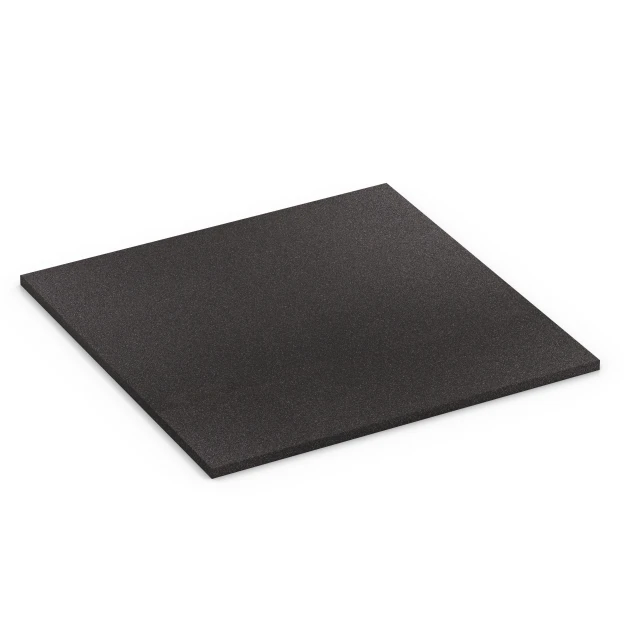
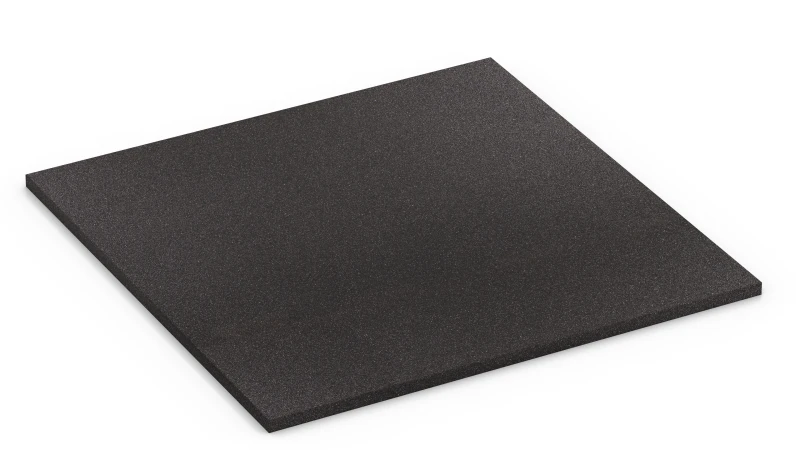
Base layer boards made from rubber granules bonded with polyurethane form part of a multi-layer flooring system and are used in constructions that absorb shock and damp vibration. Each layer in the system has a defined role. The top board forms the wearing surface. The base layer boards beneath it provide vibration and shock absorption, build-up height and load-bearing capacity. Two-layer and multi-layer sandwich constructions are possible. The boards are graded into three damping classes, ranging from very good damping to a stable yet resilient response. Base Layer Class 2 is the intermediate class, where damping and load-bearing capacity are balanced. The board is water permeable, withstands frost and is suitable for indoor and outdoor use.
What does Base Layer Class 2 do?
Base Layer Class 2 takes medium static and dynamic loads, such as those produced by setting down dumbbells, jumping or running. On impact, kinetic energy must be dissipated over the distance through which the board deforms. The board compresses, slows the load and converts some of the energy into heat. The available deflection must match the load. If a layer yields too readily, it reaches the limit of its travel before the load has come to a stop. The board then bottoms out and transfers much higher peak impact forces to the subfloor. Base Layer Class 2 has a density of 800 kg/m³, placing it in the middle range. It yields more under load than Class 1 and therefore provides noticeably better shock absorption. At the same time, it resists compression sufficiently to carry medium loads without bottoming out. This reduces peak impact forces on the screed and structural slab. It also reduces the transmission of impact sound and structure-borne sound.
What is Base Layer Class 2 suitable for?
Base Layer Class 2 is used where medium static and dynamic loads occur and noticeable damping is also required. Typical applications include indoor and outdoor fitness and training areas with dumbbells, cardio equipment and functional training spaces. Base Layer Class 2 is also suitable for areas where impact sound and vibration need to be reduced. Almost all WARCO floor coverings can form the wearing surface. Concrete or natural stone slabs can also be used as the top layer.
Why use several layers rather than one thick board?
Base Layer Class 2 can be combined with base layer boards in Classes 1 and 3. This allows damping and load-bearing capacity to be distributed progressively across several layers. A lower Class 3 layer, for example, increases shock absorption. The Class 2 layer above it spreads the load over a wider area, preventing the more yielding layer from bottoming out. An additional Class 1 layer can be included for high point loads indoors. This allows damping, load-bearing capacity and build-up height to be matched to the requirements of the area. A sandwich construction is also more durable and economical than a single thick board because only the top board needs replacing when it wears.
How is Base Layer Class 2 installed?
Base Layer Class 2 is laid loose without mortar or adhesive, edge to edge and with staggered joints. In multi-layer constructions, the layers are also staggered in relation to each other, so each joint lies over a continuous board in the layer below. The build-up height is determined by the chosen thickness of 1.8 cm or 2.8 cm and the number of layers. Base Layer Class 2 is cut with a circular saw or jigsaw.


Discount
Product Highlights
Characteristics
Product Details – Material and Structure


Comparative values
An XT tile can be laid directly as a floor covering or on an underlay of XX functional tiles. Depending on the configuration, the floor build-up is single-layer, two-layer or multi-layer.
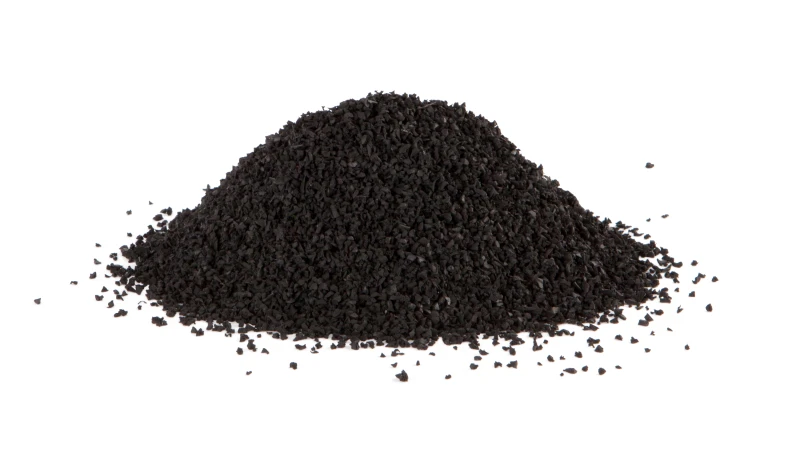
The XT tile is made entirely from recycled tyre rubber granules (ELT), or has a body of these granules with a permanently bonded top layer of coloured EPDM rubber granules. A three-dimensional interlock is cut into the tile edges: during installation, the teeth of one tile engage in the matching recesses of the next, creating a continuous tiled surface. XT tiles are 1.8 or 2.8 cm thick and come in three density grades: elastic, standard and stable.
The XX functional tile is also made from recycled tyre rubber granules (ELT). Beneath the XT tile, it spreads point loads, damps vibrations and impact sound, increases shock absorption and adds to the overall build-up height. It is likewise 1.8 or 2.8 cm thick and is offered in three damping classes. The functional tiles are laid edge to edge. In a multi-layer construction, the tiles should be offset from one layer to the next so that the joints do not align.
An XT tile combined with one or more functional tiles forms a sandwich construction. The thickness and density of the XT tile are selected for the intended application. In a sandwich construction, the thickness and damping class of the functional tiles are selected as well. Tiles of different densities can also be combined in a multi-layer construction to match the properties of the floor build-up to the application.
Where rubber tiles are laid in several layers, the load-bearing capacity, shock absorption and overall thickness of the floor can be tailored to the intended use. The XT surface tile forms the top, visible layer and determines abrasion resistance. One or more XX functional tiles sit beneath it. Both XT surface tiles and XX functional tiles are made from PU-bound rubber granules and are available in a range of thicknesses and densities.
The choice and combination of the two tile types sets the overall thickness, load-bearing capacity and shock absorption of the system, allowing it to be tailored to the application. Systems of the same overall thickness can offer different levels of shock absorption. In playgrounds, a system designed for shock absorption can offer a higher critical fall height.
In weight-training areas, a shock-absorbing system can dissipate some of the impact energy. Indoors, it can improve impact sound insulation and reduce the transmission of structure-borne sound. It can also improve vibration damping beneath machinery and plant, or in vibration-sensitive areas.
A rubber tile’s class indicates how much cushioning it provides underfoot and how much weight it can support: class 1 supports the most weight, class 3 provides the most cushioning, and class 2 falls between them on both counts. The more cushioning a tile provides, the more it gives under load.
Class 1 gives the least under load because it has the highest load-bearing capacity and provides the least cushioning. It spreads heavy loads applied at a single point across its surface and reduces vibration. It is for indoor use only.
Class 2 can be used indoors or outdoors. It has moderate load-bearing capacity and cushioning, offering a balance of support and give underfoot. It is typically laid beneath patio and balcony coverings or paving slabs, and in entrance areas.
Class 3 has the lowest load-bearing capacity and provides the most cushioning. It gives the most under load and absorbs the most impact energy, so it is suitable where a springy surface and noise reduction are needed. It can be used indoors or outdoors. All three classes are available in two sizes, 52 × 52 cm and 104 × 104 cm, and two thicknesses, 1.8 cm and 2.8 cm.
A rubber tile at least 2 cm thick will support a weight rack. A two-layer floor will also support one, provided a Class 1 load-bearing tile forms the base beneath the rack.
Load-bearing capacity is the first consideration for a weight rack. The rack’s static load is concentrated at just a few points of contact with the floor. Setting down or dropping a weight also creates a brief impact load over a small area. The flooring must carry the sustained load without excessive deflection, while cushioning impacts and reducing vibration and impact noise transmitted to the subfloor.
A single-layer floor therefore needs a load-bearing rubber tile at least 2 cm thick. Fitness Performance Impact gym flooring, which is 3 cm thick, is one example. Tiles 1 or 1.5 cm thick are not sufficient to support the constant weight of a weight rack.
In a multi-layer floor, the layers can have different densities and serve different purposes. A Class 1 tile forms the load-bearing base but is intended for indoor use only. Above it, the visible Wearing layer is either a surface tile or firm gym flooring such as Fitness Performance Elite. The layers can be combined to provide load-bearing capacity and cushioning suited to the location and its use.
Functional tiles in Classes 2 and 3 can be used outdoors beneath a rubber tile covering, whereas Class 1 tiles are intended for indoor use only. The class determines the load-bearing capacity and cushioning of the floor build-up.
Within the floor build-up, Class 2 combines load-bearing capacity with resilience underfoot and is commonly used beneath terrace and balcony coverings and paving slabs, and in entrance areas. Class 3 is used where impact cushioning is the main requirement, for example beneath playground surfacing.
Both types of functional tile are made from rubber granules recovered from end-of-life tyres (ELT), withstand frost and are permeable over their whole area. Their underside has square bearing pads with broad, shallow drainage channels, allowing rainwater to drain away beneath the covering on impermeable substrates rather than collecting within the build-up.
An XT system can be as little as 1.8 cm thick. There is no maximum thickness, as any number of tiles can be stacked. Whatever the overall thickness, the XT surface tile is always on top. It can be used on its own, without a functional tile, or placed over one or more XX tiles that form the functional layers.
Both the surface tile and the tiles used for the functional layers are available in thicknesses of 1.8 cm and 2.8 cm. Any number of functional tiles can be combined, in either thickness. The overall thickness is the sum of the thicknesses of all the tiles in the stack. Using both 1.8 cm and 2.8 cm tiles allows the overall thickness to be adjusted in smaller increments.
Different combinations of tiles can produce the same overall thickness, but may differ in load-bearing capacity and cushioning. The choice of combination depends on how the finished surface will be used.
Different rubber tiles can be combined in a layered system. Type XX tiles are available in three cushioning grades; any number can be used in any order beneath the surface tile. Each of these layers can have its own cushioning grade, density and thickness. The visible surface is formed by a type XT surface tile or another surface tile, whose density and elasticity need not match those of the tiles beneath it.
The order of the layers depends on how the area will be used and the performance required of the layered system. The layers are selected and arranged to balance shock absorption, load-bearing capacity and how point loads are spread. Two systems of the same overall height can therefore differ in load-bearing capacity, elasticity and damping.
Where rubber tiles are laid in more than one layer, the joints in each layer should be staggered rather than positioned directly above one another. In a multi-layer build-up, each layer is offset from the one below so that the tiles in the upper layer bridge the joints in the layer beneath.
Staggering the joints in this way avoids joint lines running straight through the build-up and helps to keep the finished surface even. Outdoors, it also leaves no continuous path for vegetation to grow up from the ground beneath.
Where rubber tiles are installed in more than one layer, the layers should not be bonded to one another but loose-laid.
PU-bound rubber granules expand and contract with changes in temperature and moisture, swelling in warm conditions and shrinking in the cold. With loose-laid layers, each layer can move independently of the others.
The interlocking profile of the tiles in the top layer, together with the weight of the whole construction, helps hold it in place. If maintenance or repair work is needed later, the layers can be lifted one at a time, so that each can be checked and replaced where necessary.
In a sandwich system, when the surface of the top tile becomes worn, usually only that tile needs replacing. The tiles beneath it generally last much longer and need replacing much later than the top tile.
The Wearing layer is subject to abrasion as people walk, exercise and play on it. The tiles beneath are not exposed to direct sunlight or surface abrasion, so in most cases they can remain in place and be reused.
Reusing the lower tiles and replacing only the top tile costs considerably less than replacing the entire floor covering. A new top tile in a different colour also allows the surface colour to be changed without relaying the entire floor.
Different tile sizes can be combined in a floor with more than one layer. Surface tiles and functional tiles are designed to be used together in this way, rather than stacked with their joints aligned.
Allowing for joints, each surface tile occupies 44.6 × 44.6 cm or 97.1 × 97.1 cm. Functional tiles, by contrast, come in 52 × 52 cm or 104 × 104 cm sizes and are laid with butt joints, without interlocking edges. Their nominal dimensions are therefore also the dimensions used to calculate coverage.
The layers are laid to different grids so that their joints are offset as intended. Joints in the upper and lower layers never align to form a continuous joint through the floor.
The number of tiles must therefore be calculated separately for each layer. The floor area to be covered is the same for both, but the number of tiles required depends on the coverage dimensions of each tile type.
Rubber granule mats of any thickness can be cut with a jigsaw or a circular saw. A circular saw is suited to straight cuts, while a jigsaw is suited to curved cuts and cut-outs. PU-bound rubber granules can be worked in much the same way as wood, provided both saws are guided steadily with an even feed rate.
For particularly thick rubber mats or large sections to be cut, a reciprocating saw or chainsaw may be easier to handle than a guided circular saw. Thick impact-absorbing surfacing tiles also do not require a special machine: a coarse-toothed wood saw blade or a rubber saw blade is suitable. A coarse tooth pattern and moderate speed keep frictional heat low, allowing fitness tiles and patio tiles made from rubber granules to be cut cleanly.