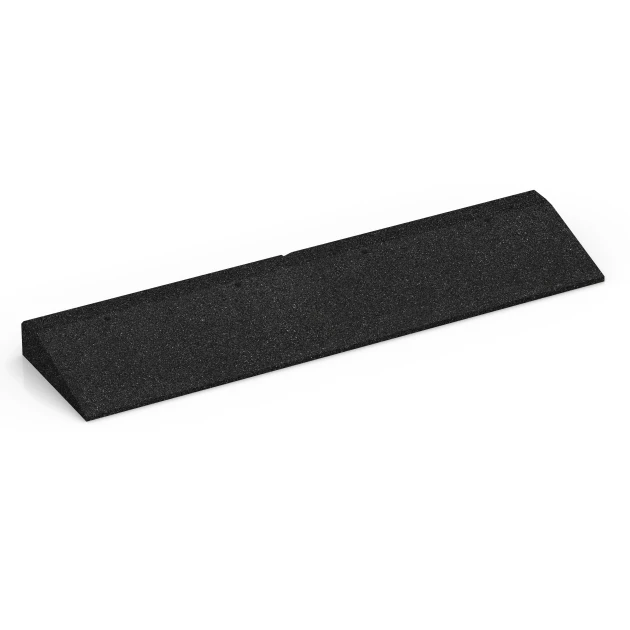
Threshold Ramp RM "Anthracite"
- /
-
Ready to ship
from stock in 1-3 days - £22.40 / 1 Piece / lin. m.
- (8.80 kg / Piece)
EAN: 4251469366008 | Item no.: 6600
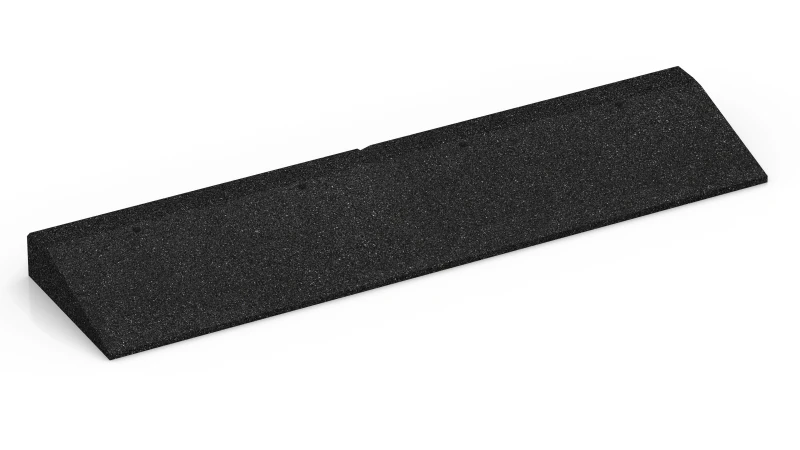
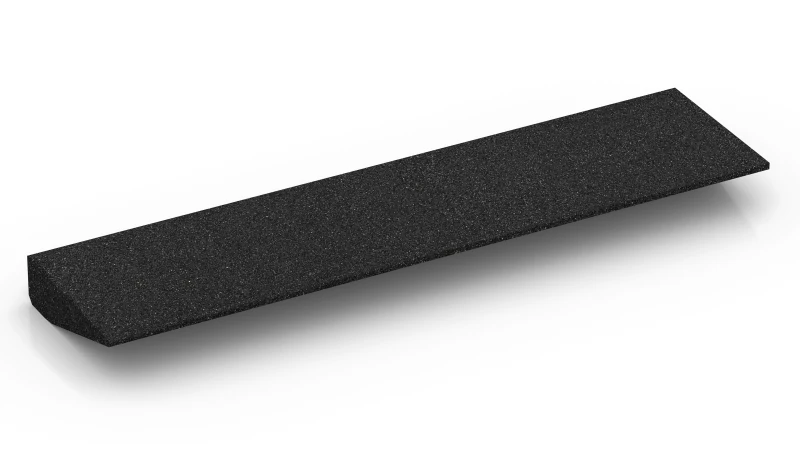
The threshold ramp made from PU-bound rubber granulate compensates for level changes between adjacent surfaces and reduces trip hazards. It enables a safe, step-free transition where different surface build-ups meet, for example between a paved playground and an area fitted with impact-absorbing tiles. Such transitions commonly occur when an additional surface layer is applied to part of an existing area.
Geometry and variants
The ramp measures 100 cm in length and 25 cm in width. The low edge height is 1 cm, ensuring sufficient thickness even at the thinnest point to maintain structural integrity along the tapered edge. The opposite, higher edge is available in 3, 4, 4.5, 5, 6, 7, 8, 9 and 10 cm. This range allows precise alignment with adjoining surfaces such as safety tiles, fitness tiles or other modular rubber coverings.
Typical applications
A threshold ramp creates a smooth transition between surfaces of differing heights and can be used wherever thresholds, kerbs or edges need to be negotiated. Common applications include door thresholds, patio doors and kerbstones in both public and private settings. The ramp is suitable for outdoor installations such as playgrounds and landscaped areas, as well as for indoor environments including entrances and circulation zones.
Structure and surface properties
Manufactured from PU-bound rubber granulate with a medium grain size and density, the ramp combines elasticity with a stable structure. The surface provides reliable slip resistance underfoot and for wheeled movement. Its open-pored structure allows water to drain through while also reducing impact sound and rolling noise. This contributes to smoother movement for wheelchairs, pushchairs, trolleys or maintenance equipment.
Installation and fixing options
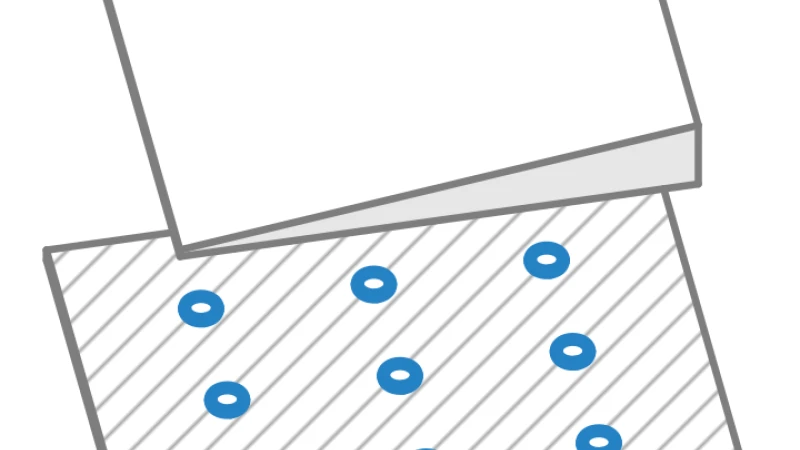
The ramp can be installed as a free-standing element or permanently fixed. For bonded installation, a suitable PU adhesive is applied to the prepared substrate. Alternatively, mechanical fixing is possible via four integrated screw sockets embedded in the ramp. These reinforced points allow secure attachment using screws selected according to the specific substrate on site.


Discount
Product Highlights
Characteristics
Product Details – Material and Structure
Comparative values
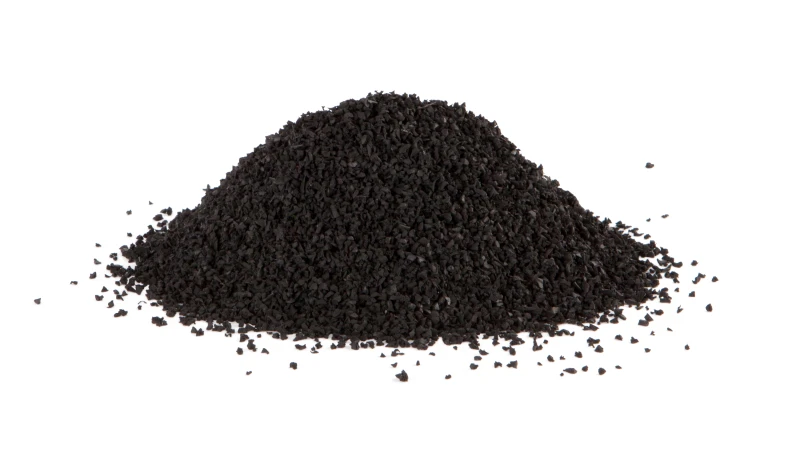
Rubber granules from end-of-life tyres are produced from tyres that are no longer in service. ELT stands for End-of-Life Tyres, the established term for tyres that have reached the end of their usable life. The resulting granules are a recycled raw material.
Collected car and lorry tyres provide the feedstock for processing. The tyres are shredded before the steel and textile fibres are separated. The remaining rubber is processed into black granules with a range of particle sizes, then separated into defined grades.
Tyres contain mainly styrene-butadiene rubber (SBR) and natural rubber (NR), so both types of rubber are present in the recovered granules. The term SBR rubber granules is common in the trade, but it does not make the origin clear, because SBR can also be newly produced and processed directly. By contrast, the term rubber granules from end-of-life tyres explicitly identifies granules recovered from used tyres.
ELT rubber granules are used in floor coverings, including sports flooring and safety tiles, as well as in road construction, building products and technical rubber goods. They are also used as the feedstock for WARCO tiles made from rubber granules bound with polyurethane. Recycling keeps the rubber in use for longer and can reduce demand for newly produced rubber.
A ramp wedge is needed as perimeter edging for a balcony or terrace only where there is a difference in level between surfaces. It is not needed for edge restraint alone.
That edge restraint is provided on balconies and terraces by existing structural boundaries such as walls and balustrades, which contain the floor covering. A difference in level may occur at a doorway threshold; in that case, the ramp wedge forms a sloping, walkable transition ramp.
Rubber mats and moulded items made from rubber granules, including rubber granule mats, are best cut with a circular saw fitted with either a wood-cutting blade or a rubber saw blade. The most appropriate tool depends on the product, the shape of the cut and the installer’s experience. The circular saw should have sufficient power, while blade speed should not be too high.
Where a utility knife is used, this method is generally more appropriate for experienced installers. The knife needs a sharp blade and a firm handle, and it should be guided along a metal straightedge or rail to maintain a straight cut edge. Several passes with moderate pressure will cut through the rubber mat. When guiding the knife along the straightedge, the hand can slip towards the blade; the guiding hand must therefore remain behind the straightedge and never in front of the blade, where the risk of injury is greatest.
For internal cuts or curved lines, a jigsaw is appropriate, using rubber saw blades made for jigsaws. Metal-cutting saws, blades intended for metal or stone, cutting discs and very high-speed saws are unsuitable because heat generated by friction can melt the rubber granules bound within the moulded item and smear the cut edge. This applies equally to rubber mats, safety surfacing tiles, fitness tiles, patio tiles and edging blocks made from rubber granules.
Rubber granule mats of any thickness can be cut with a jigsaw or a circular saw. A circular saw is suited to straight cuts, while a jigsaw is suited to curved cuts and cut-outs. PU-bound rubber granules can be worked in much the same way as wood, provided both saws are guided steadily with an even feed rate.
For particularly thick rubber mats or large sections to be cut, a reciprocating saw or chainsaw may be easier to handle than a guided circular saw. Thick impact-absorbing surfacing tiles also do not require a special machine: a coarse-toothed wood saw blade or a rubber saw blade is suitable. A coarse tooth pattern and moderate speed keep frictional heat low, allowing fitness tiles and patio tiles made from rubber granules to be cut cleanly.
Rubber tiles made from bound rubber granules are generally loose-laid and held together by a puzzle interlock or connectors; bonding is used where this arrangement does not provide sufficient restraint against movement, lifting or unauthorised removal.
Threshold ramps are bonded to a suitable substrate. On steps, the step covering is bonded to the existing steps. Impact protection is bonded to walls or pillars in garages, car parks and work areas used by industrial trucks. A permanently flexible PU adhesive is suitable for bonding impact protection. Where the fixing needs to remain easily removable later, strongly adhesive carpet tape may be used instead, depending on the substrate and loading.
Small cut pieces and unsecured edge pieces are edge-bonded to adjacent tiles. On small areas, point fixing may be necessary. It may also be necessary for raised corners of tiles with a concealed puzzle interlock or where there is a higher risk of displacement. In publicly accessible areas, point fixing makes individual tiles harder to lift or remove.
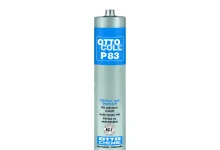
For bonding rubber tiles or rubber flooring, one cartridge of PU adhesive OP83 provides around 310 dots of adhesive when approximately 1 ml is applied to each dot. Actual consumption depends on the laying conditions and on the condition of both the rubber tiles and the substrate.
The adhesive is applied to one of the surfaces to be bonded in pea- to hazelnut-sized dots. Smoother, flatter surfaces require less adhesive, whereas rough and porous surfaces require more adhesive for a lasting bond.
Pragovne rampe iz gumijastega granulata iz recikliranih pnevmatik (ELT) so antracitne do črne barve. Od 100 kosov naprej jih je mogoče izdelati tudi iz barvnega EPDM granulata. Za izvedbo iz ELT se uporablja brezbarvno vezivo.