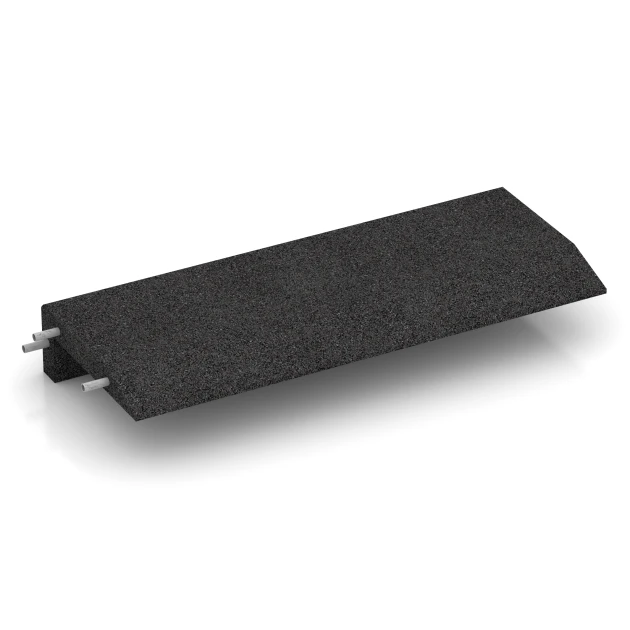
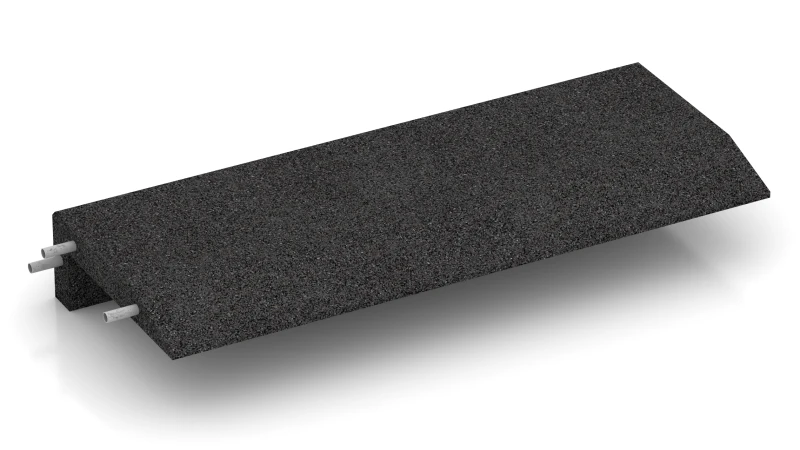
Rubber Wall Coping SR "Anthracite"
- /
-
Ready to ship
in approx. 7-14 days – production already under way - £38.70 / 1 Piece / lin. m.
- (18.30 kg / Piece)
EAN: 4251469326071 | Item no.: 2607
Rubber Wall Coping is an L-shaped wall coping made from polyurethane-bound rubber granules for the tops of concrete or stone walls. The elastic, shock-absorbing covering cushions the hard wall edge and turns the top of the wall into a comfortable seating surface.
What shape is the wall coping?
The wall coping covers the entire top surface of the wall. A leg on one long side extends down over the vertical front face and covers the edge that people may knock against. The opposite long side slopes down to form a shallow transition instead of a raised edge that could be tripped over.
Where is the wall coping used?
The wall coping is used as a wall edge protector in playgrounds, school playgrounds, parks and leisure facilities. It covers wall tops, low walls used as seating, concrete steps and changes in ground level. It can also be fitted retrospectively to U-shaped concrete seating units. If someone falls onto it or bumps against it, the wall coping cushions the impact and reduces the risk of injury.
How is the wall coping used around a sandpit?
The wall coping cushions the edge of a sandpit enclosed by an existing low wall or concrete border. The covered edge becomes a seat for children and parents. If the sandpit is set flush into a paved area, the slope runs gently down to the surrounding surface.
How is the wall coping fitted?
The wall coping is bonded to the sound, clean top of the wall with elastic PU adhesive. The adhesive can be applied across the full surface or at individual points. Plastic dowels help during fitting and keep adjacent sections in line. The wall coping is cut to size during installation with a circular saw or jigsaw.
What is the wall coping made from?
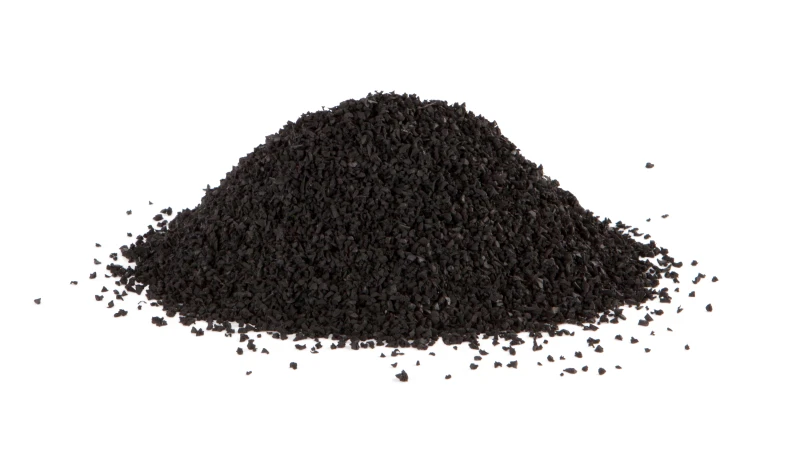
The wall coping is made from recycled tyre rubber granules (ELT) bound with polyurethane. ELT stands for end-of-life tyres. The wall coping is water-permeable, so the seating surface dries quickly after a shower. The surface is grippy, while the material is frost-resistant and weather-resistant. The wall coping needs very little care because rain washes away loose surface dirt.


Discount
Product Highlights
Characteristics
Product Details – Material and Structure

Comparative values
Outdoor rubber tiles made from polyurethane-bound rubber granules are frost-resistant and suitable for use throughout the winter. Their porous structure absorbs precipitation and allows it to pass downwards; water remaining in the pores has space to expand when it freezes, while the rubber granules and polyurethane binder remain elastic at sub-zero temperatures. The sub-base must also be constructed to withstand frost.
On bound sub-bases, water flows beneath and between the tiles in the direction of the fall towards the drainage system. On chippings or crushed stone, it drains vertically through the construction. If water collects beneath the tiles, a frost-susceptible sub-base may rise and then settle again after thawing. The tiles themselves remain unaffected, but the surface may become more uneven.
For winter maintenance, use a snow shovel with a smooth edge and avoid catching the tile edges. Salt used in normal quantities to melt ice does not harm the rubber granules.
Rubber mats and moulded items made from rubber granules, including rubber granule mats, are best cut with a circular saw fitted with either a wood-cutting blade or a rubber saw blade. The most appropriate tool depends on the product, the shape of the cut and the installer’s experience. The circular saw should have sufficient power, while blade speed should not be too high.
Where a utility knife is used, this method is generally more appropriate for experienced installers. The knife needs a sharp blade and a firm handle, and it should be guided along a metal straightedge or rail to maintain a straight cut edge. Several passes with moderate pressure will cut through the rubber mat. When guiding the knife along the straightedge, the hand can slip towards the blade; the guiding hand must therefore remain behind the straightedge and never in front of the blade, where the risk of injury is greatest.
For internal cuts or curved lines, a jigsaw is appropriate, using rubber saw blades made for jigsaws. Metal-cutting saws, blades intended for metal or stone, cutting discs and very high-speed saws are unsuitable because heat generated by friction can melt the rubber granules bound within the moulded item and smear the cut edge. This applies equally to rubber mats, safety surfacing tiles, fitness tiles, patio tiles and edging blocks made from rubber granules.
Rubber granule mats of any thickness can be cut with a jigsaw or a circular saw. A circular saw is suited to straight cuts, while a jigsaw is suited to curved cuts and cut-outs. PU-bound rubber granules can be worked in much the same way as wood, provided both saws are guided steadily with an even feed rate.
For particularly thick rubber mats or large sections to be cut, a reciprocating saw or chainsaw may be easier to handle than a guided circular saw. Thick impact-absorbing surfacing tiles also do not require a special machine: a coarse-toothed wood saw blade or a rubber saw blade is suitable. A coarse tooth pattern and moderate speed keep frictional heat low, allowing fitness tiles and patio tiles made from rubber granules to be cut cleanly.
Rubber tiles made from bound rubber granules are generally loose-laid and held together by a puzzle interlock or connectors; bonding is used where this arrangement does not provide sufficient restraint against movement, lifting or unauthorised removal.
Threshold ramps are bonded to a suitable substrate. On steps, the step covering is bonded to the existing steps. Impact protection is bonded to walls or pillars in garages, car parks and work areas used by industrial trucks. A permanently flexible PU adhesive is suitable for bonding impact protection. Where the fixing needs to remain easily removable later, strongly adhesive carpet tape may be used instead, depending on the substrate and loading.
Small cut pieces and unsecured edge pieces are edge-bonded to adjacent tiles. On small areas, point fixing may be necessary. It may also be necessary for raised corners of tiles with a concealed puzzle interlock or where there is a higher risk of displacement. In publicly accessible areas, point fixing makes individual tiles harder to lift or remove.
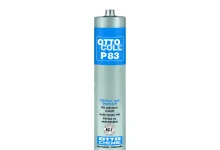
For bonding rubber tiles or rubber flooring, one cartridge of PU adhesive OP83 provides around 310 dots of adhesive when approximately 1 ml is applied to each dot. Actual consumption depends on the laying conditions and on the condition of both the rubber tiles and the substrate.
The adhesive is applied to one of the surfaces to be bonded in pea- to hazelnut-sized dots. Smoother, flatter surfaces require less adhesive, whereas rough and porous surfaces require more adhesive for a lasting bond.