
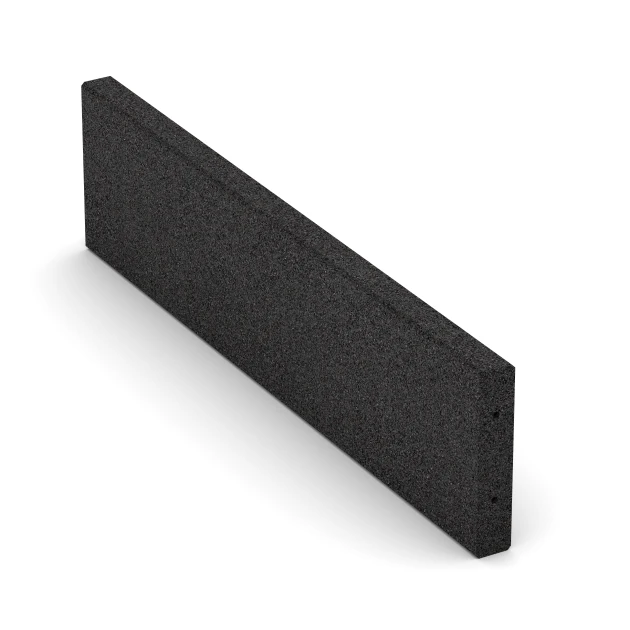
Rubber Kerb RV "Anthracite"
-
This product is currently unavailable.
/ - 1 Piece / lin. m.
- (10.10 kg / Piece)
EAN: 4251469325968 | Item no.: 2596
The WARCO Rubber Kerb is a durable, flexible edging solution for playgrounds, pathways, sports surfaces and garden areas.
When set into a concrete foundation with a backing support, it forms a stable, long-lasting and impact-absorbing border that enhances both safety and aesthetics.
Material and structure
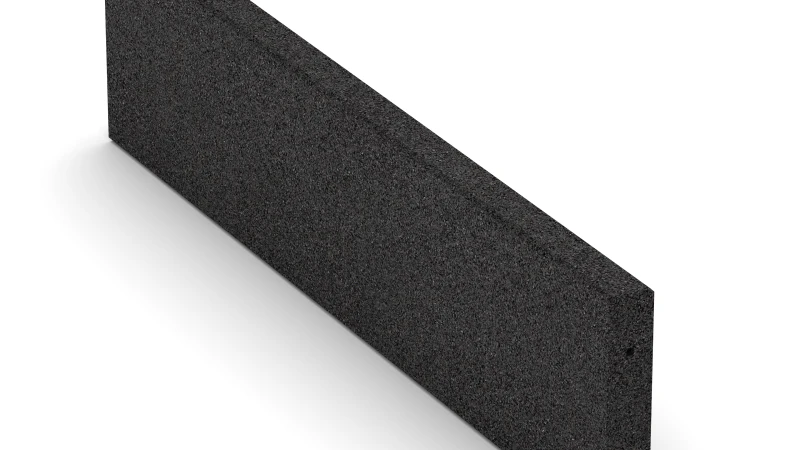
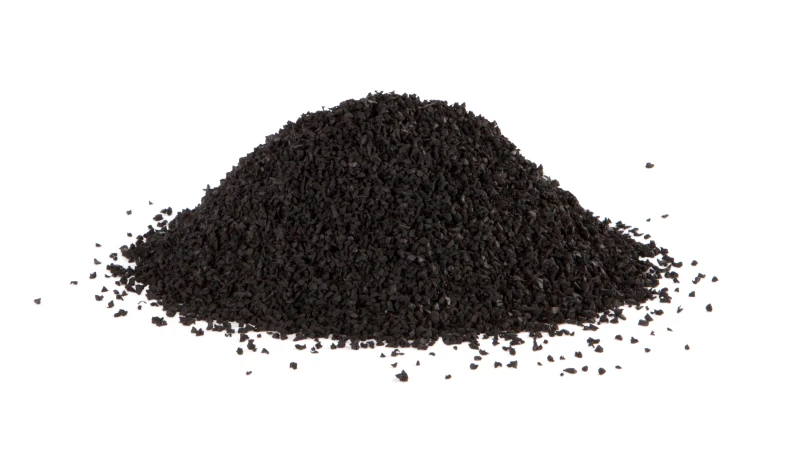
Each kerb measures 100 × 25 × 5 cm and is made from PU-bound ELT rubber granulate (End-of-Life Tyres).
The material is resilient, weatherproof and dimensionally stable.
Its finely textured, slip-resistant surface feels firm yet comfortable underfoot.
It withstands frost, moisture and UV exposure and maintains its shape and colour for years without cracking or splintering.
Installation
The kerbs are placed on a stable, frost-resistant sub-base and embedded in a concrete foundation with a backing support.
Plastic dowels serve as convenient installation guides, ensuring precise alignment and a uniform line during installation – even when creating gentle curves or arcs.
Function and applications
The Rubber Kerb is ideal for edging pathways, playgrounds, sports areas, lawns and flower beds.
Its shock-absorbing rubber composition reduces the risk of injury and provides a clearly defined, safe boundary.
It can also serve a decorative function, such as wall capping or protective edging along steps, walls or borders.
Advantages and features
• Flexible, safe and impact absorbing
• Resistant to frost, moisture and UV exposure
• Textured, non-slip surface
• Suitable for straight or curved layouts
• Low maintenance with a long service life


Product Highlights
Characteristics
Product Details – Material and Structure


Comparative values
An edge restraint is needed to prevent lateral movement at the free edges of an area laid on an unbound sub-base.
An edging kerb, also known as a kerbstone or edging stone, provides this restraint. It is particularly relevant for block paving, paving slabs and rubber paving tiles with interlocking connectors. Existing firm boundaries can also provide lateral restraint.
The edge restraint forms the lateral abutment for the surfacing. It absorbs horizontal forces arising from use and movements caused by temperature changes. This keeps the outer blocks or tiles in their intended position, stabilises the joint pattern and prevents movement at the edges.
No additional edge restraint is required where the surfacing is already permanently bounded by an adjoining concrete area, a wall or a fixed building edge.
Independently of its structural function, an edging kerb can provide a clean separation between paths or surfaced areas and grass, garden beds or sand areas. Typical applications include garden-bed edging and the perimeter of beach volleyball courts.
The edging kerb is installed upright on a concrete bed and secured laterally with a concrete haunch. Approximately 65% of its height is below finished ground level. A load-bearing, adequately drained substrate that is not susceptible to frost is required for a permanently stable edge.
Flexible edging kerbs are suitable for both straight and curved edges.