Fitness Performance Impact Rubber Gym Flooring ED "Anthracite"
- /
-
Ready to ship
from stock in 1-3 days - £30.20 / 1 Piece / m²
- (15.30 kg / Piece)
EAN: 4251469337831 | Item no.: 3783
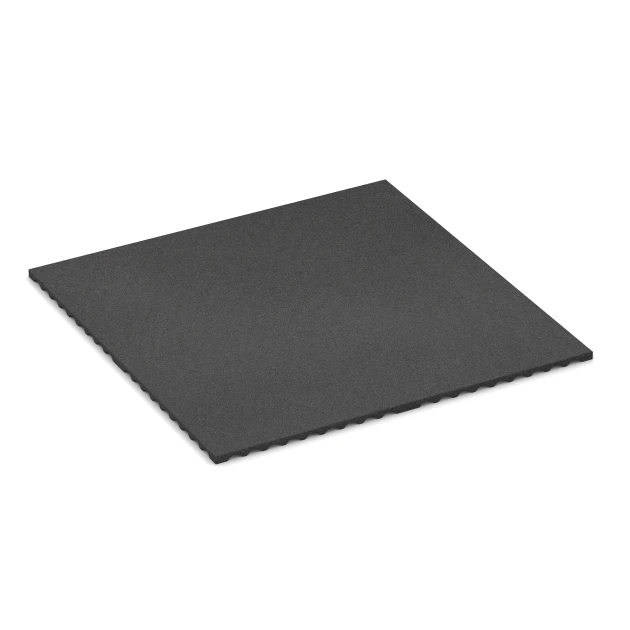
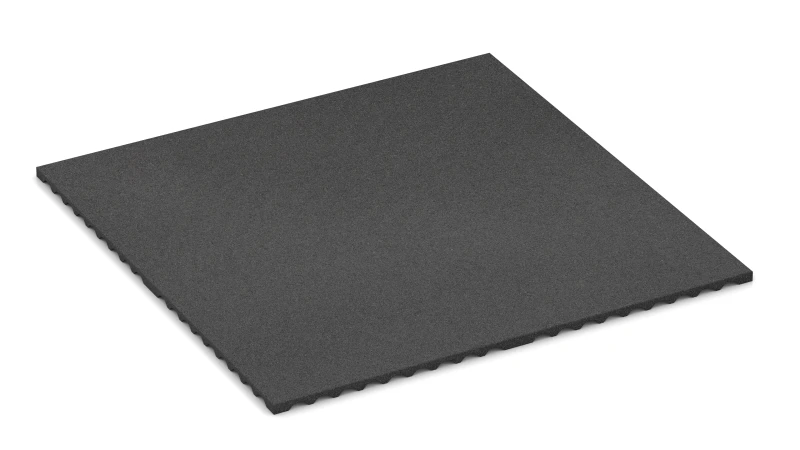
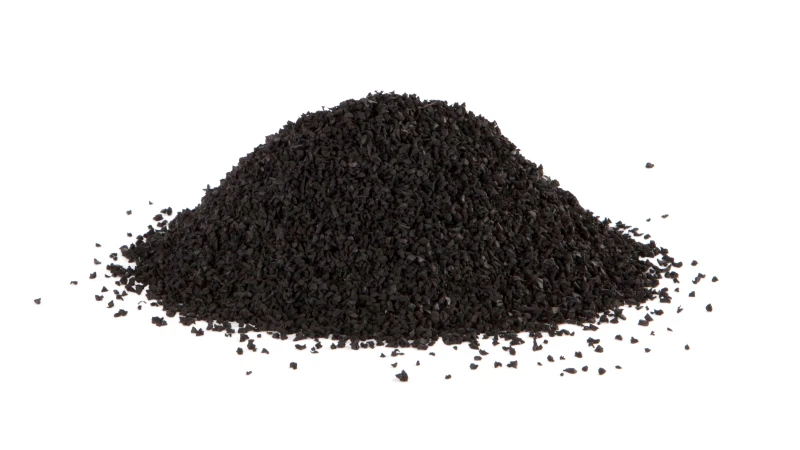
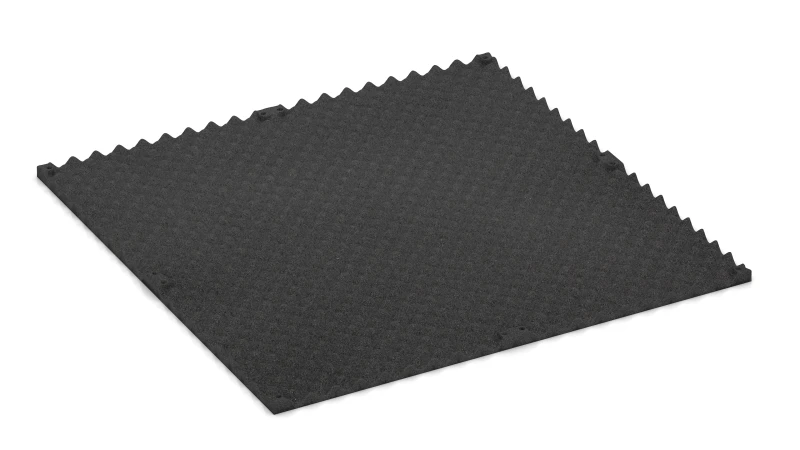
Fitness Performance Impact Rubber Gym Flooring is designed for indoor training zones where people train directly on the floor. Each tile consists of processed ELT rubber granules recovered from end-of-life tyres. The granules have a fine to medium grain size and are permanently bonded with an elastic polyurethane binder. High density makes the flooring stable under pressure and resistant to abrasion. The elastic structure and profiled underside absorb impacts and make training noticeably quieter. The flooring is intended for busy training areas in gyms, CrossFit boxes, HYROX areas, group exercise studios and home gyms.
What does the studded underside do?
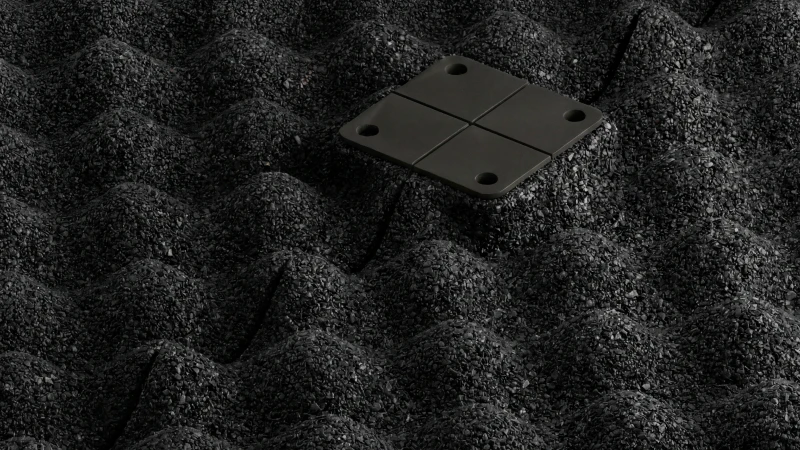
Fitness Performance Impact Rubber Gym Flooring has studs moulded across the entire underside. This structure acts like a shock absorber. The studs absorb energy from movement and distribute it evenly. This protects the subfloor. The tile itself retains its shape and remains firm underfoot.
What can the flooring withstand?
Fitness Performance Impact Rubber Gym Flooring protects athletes, equipment and the subfloor alike. It retains its shape over time, even with high footfall. Where heavy barbells are dropped, the training floor needs a multi-layer build-up with type XX base layer tiles underneath.
How are the tiles laid and connected?
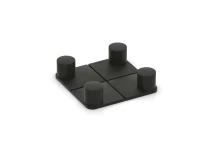
Fitness Performance Impact Rubber Gym Flooring is laid loose without mortar or adhesive (dry-laid). Plastic clips can be added on request. They create a firm surface that can still be taken apart. This is particularly practical for large areas and temporary training spaces. Edge tiles are cut to size with a circular saw or jigsaw. The surface is grippy and comfortable to walk on.
How is the flooring cleaned?
Fitness Performance Impact Rubber Gym Flooring is easy to clean. A vacuum cleaner and mop are sufficient. Disinfectants can also be used. The material is toxicologically safe.


Discount
Product Highlights
Characteristics
Product Details – Material and Structure
Comparative values
Impact-absorbing flooring made from PU-bound rubber granules reduces impact sound and the structure-borne sound it generates. The elastic floor covering absorbs impacts and reduces their transfer to the substrate.
Impact sound occurs when walking, jumping, moving furniture or setting down weights cause a floor or storey slab to vibrate. These vibrations travel through solid building components as structure-borne sound and can become audible as airborne sound in other rooms.
Structure-borne sound can also be caused by machinery and by installations fixed to the building. It may have causes and transmission paths other than impact sound, so it cannot be reduced by a floor covering alone.
Under load, a floor covering made from rubber granules deforms elastically. This deformation transfers the load to the substrate less abruptly, reduces the peak force and, through the covering’s internal damping, further weakens the remaining vibrations.
Sound-insulation tiles reduce excitation of the substrate from footsteps, jumps and impacting objects. Where higher requirements apply, multi-layer flooring systems with functional layers of differing elasticity can further reduce impact transmission. Their effectiveness depends on the properties of each layer, the load applied, and the existing floor or slab structure.
The number of tiles required for an irregular area can be calculated manually or determined using the digital laying planner.
For irregular areas, a scaled laying plan on graph paper is recommended. For the manual calculation method, draw the area on graph paper at a scale of 1:100, where 1 cm corresponds to 1 m. Place the tile grid over the drawing and draw the tiles within the area according to their laying dimensions. The drawing shows where offcuts will be required and allows the required number of tiles to be counted.
The online laying planner determines the quantity required more quickly than the manual calculation method. It is available for every product in the online shop. Once the area dimensions have been entered, the tool automatically calculates the number of tiles required and displays a suitable laying pattern. On the product page, simply click ‘Plan installation’. The planner works directly in the browser, is free of charge and does not require registration.