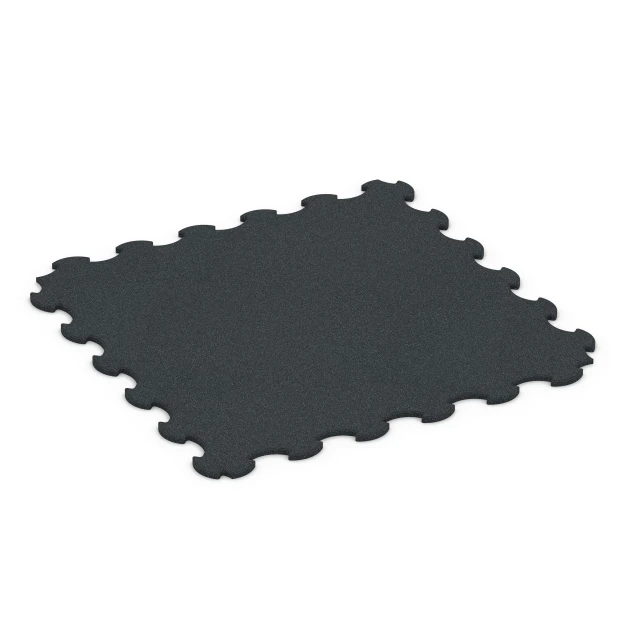
Fitness Floor Protection Mat RZ "Anthracite"
- /
-
Ready to ship
from stock in 1-3 days - £31.33 / 0.95 Piece / m²
- (13.50 kg / Piece)
EAN: 4251469363762 | Item no.: 6376
The WARCO Fitness Floor Protection Mat is the universal solution for gyms, home workout areas and outdoor fitness facilities that require a safe, comfortable and resilient training surface.
Elastic and shock-absorbing
The mats are made of PU-bonded rubber granulate and are available in thicknesses of 3, 4 or 5 cm. They reliably absorb impacts, reduce vibrations and dampen noise. Joints, tendons and ligaments are noticeably relieved, while the subfloor is effectively protected.
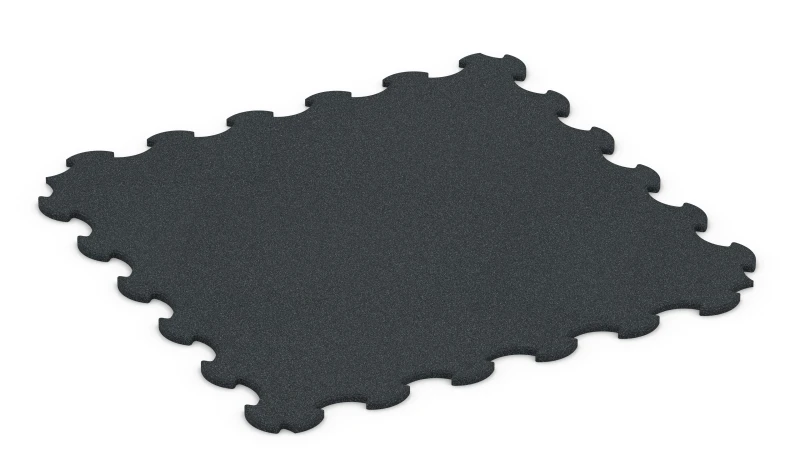
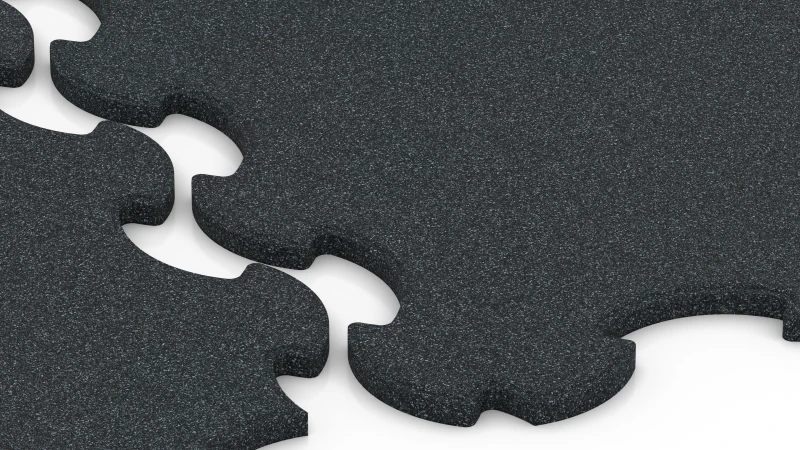
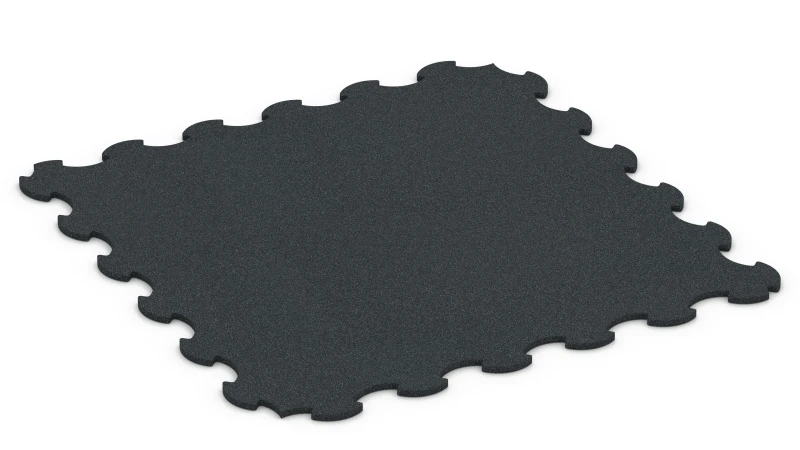
Moulded puzzle interlock with bevel
Each mat features a precisely moulded puzzle interlock that is easy to connect with a perfect fit. The surrounding bevel ensures a clean, organised joint pattern and gives the surface a high-quality appearance. The result is a stable, form-fitting carpet of tiles.
For various applications – indoors and outdoors
Whether in free weight areas, functional training zones, course rooms or outdoor fitness areas, the Fitness Floor Protection Mat is highly versatile. Thanks to the different thicknesses, the floor can be adapted to the level of stress: 3 cm for moderate use, 4 cm for intensive training and 5 cm for maximum cushioning and comfort.
Easy installation and maintenance
The mats can be laid quickly and easily without adhesive. Individual elements can be replaced or repositioned if required. Maintenance is straightforward – vacuuming, sweeping or wiping with standard cleaning agents is sufficient, even outdoors.
Quality from the manufacturer
The Fitness Floor Protection Mat is robust, durable, weather-resistant, hygienic and toxicologically safe. It combines safety, comfort and a neat appearance – ideal for professional gyms, outdoor fitness facilities and demanding home users.




Discount
Product Highlights
Characteristics
Product Details – Material and Structure

Comparative values
Rubber flooring for exercise equipment in an outdoor gym can be made from PU-bound rubber granules. It is slip-resistant, shock-absorbing, weather-resistant and frost-resistant.
For outdoor use, porous, water-permeable gym tiles are used. Rainwater passes through the tiles across their entire area, while the surface provides stable footing when wet.
Thickness and construction depend on the intended types of training. For calisthenics, equipment training and functional training, a balance between stability and shock absorption is required. Tiles of about 3 cm are suitable for many of these applications.
As well as thickness, density and construction affect the properties of rubber flooring. For kettlebells, barbells and other heavy weights, thicker tiles or multilayer surfacing systems are appropriate.
Where impact-absorbing surfacing is required around training equipment, the critical fall height determined in accordance with BS EN 1177 must be at least equal to the required free height of fall.
The number of tiles required for an irregular area can be calculated manually or determined using the digital laying planner.
For irregular areas, a scaled laying plan on graph paper is recommended. For the manual calculation method, draw the area on graph paper at a scale of 1:100, where 1 cm corresponds to 1 m. Place the tile grid over the drawing and draw the tiles within the area according to their laying dimensions. The drawing shows where offcuts will be required and allows the required number of tiles to be counted.
The online laying planner determines the quantity required more quickly than the manual calculation method. It is available for every product in the online shop. Once the area dimensions have been entered, the tool automatically calculates the number of tiles required and displays a suitable laying pattern. On the product page, simply click ‘Plan installation’. The planner works directly in the browser, is free of charge and does not require registration.
Visible jigsaw interlocks, plastic connectors and concealed jigsaw interlocks differ in their edge profile, joint appearance, available laying patterns and whether the tile area requires bonding or a perimeter restraint. Three variants are used for tiles made from rubber granules: visible jigsaw interlocks, plastic connectors and concealed jigsaw interlocks. With visible jigsaw interlocks, the toothed edge engages with the adjacent tile over the full tile thickness. Depending on the range, the teeth are dovetail-shaped or rounded, and are formed during pressing or cut from the tile at the factory after several days of curing. How clearly the tooth pattern remains visible across the surface depends on the edge design and colour. Where all four sides have the same tooth pattern, tiles can be laid in any direction; where the side profiles differ, the laying direction is fixed. This is the most stable of the three systems and holds the tile area together without bonding or a perimeter restraint.
Where bonding or a perimeter restraint is required, tiles with plastic connectors have straight edges and are joined by cylindrical plastic connecting pins inserted into factory-made holes in the tile sides. They are laid row by row in a half-bond installation. Each tile connects to four neighbouring tiles, with two in the preceding row and two in the following row; tiles within the same row are not connected. The plastic connector fittings limit movement across the pin axis, while tiles can still move along that axis. The tile area therefore needs bonding or a fixed perimeter restraint acting along the pin axis. An existing parapet or wall can often provide this restraint, as can an adjacent lawn at the same level, holding the tiles laterally.
Unlike the straight edges used with plastic connectors, concealed jigsaw interlocks place the toothed profile in a step on the underside, outside the visible edge area. Two tile sides carry the projecting profile, with the matching profile on the two opposing sides, which determines the laying direction. The interlock is not visible from above and the joints run in straight lines. Tiles can be laid in a stack bond or a one-third offset. Because the interlock sits within the step, the joint does not extend down to the sub-base, which remains fully covered.
Installation of many WARCO rubber tiles can be carried out without a specialist contractor.
WARCO rubber tiles can be used as flooring for patios and balconies, as fitness flooring and as playground safety surfacing. This requires the product, substrate and build-up to be appropriate for the intended application.
The tiles are loose-laid. Depending on the range, they are joined using a puzzle-style interlock or plastic connectors.
Preparation of the substrate and any necessary edge cutting can be managed with practical DIY skills.