
Safety Grass Grid Mat – 300 cm GG "Brick red"
- /
-
Ready to ship
from stock in 1-3 days - £54.30 / 1 Piece / m²
- (18.00 kg / Piece)
EAN: 4251469370104 | Item no.: 7010
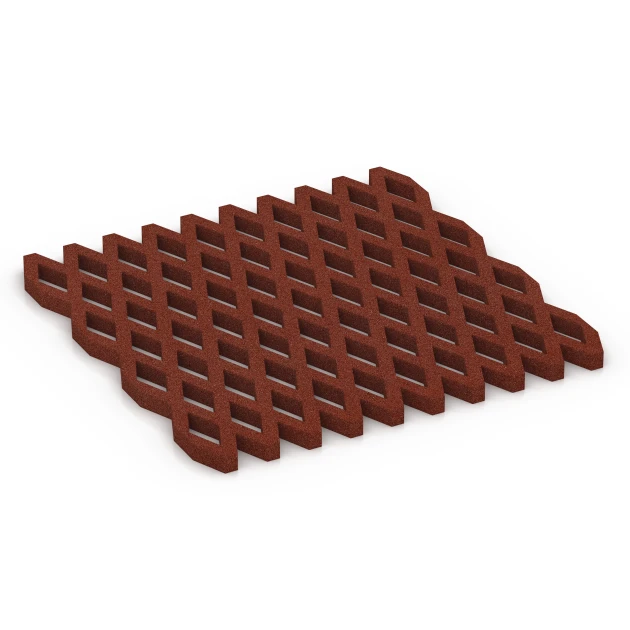
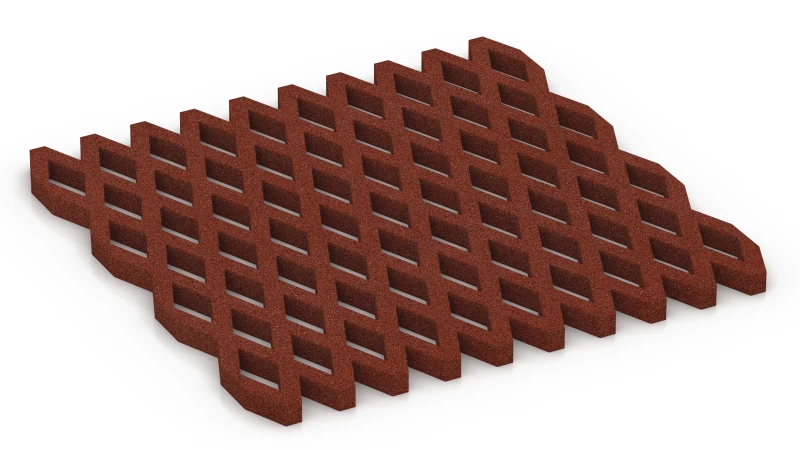
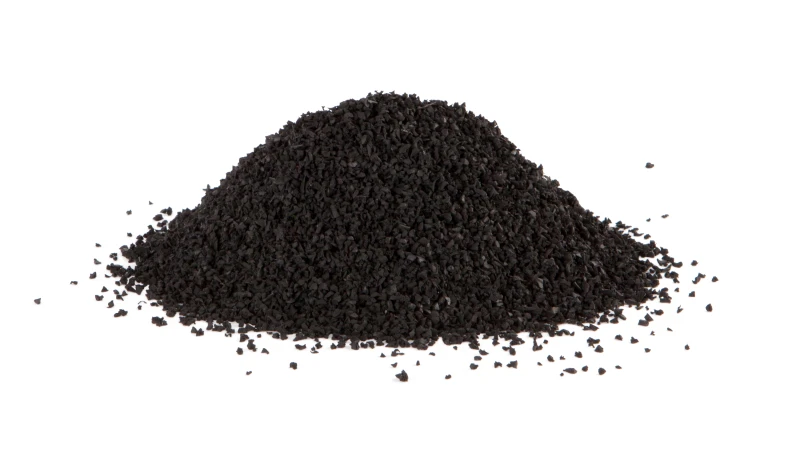
The Safety Grass Grid Mat measures 100 × 100 cm and is tested to BS EN 1177 for a critical fall height of up to 3.00 m. This applies to both the 4 cm and 8 cm thicknesses. It is made from rubber granules bonded with polyurethane and has an open grid structure. The cells are filled with growing medium, and grass grows through the grid. This keeps the play surface green while still cushioning the impact of a fall.
Which types of play equipment is the Safety Grass Grid Mat suitable for?
The Safety Grass Grid Mat is suitable for play equipment with a free height of fall of up to 3.00 m. Examples include swings, climbing towers, climbing nets and large multi-play structures on playgrounds, in nurseries and in recreation areas where the surface is to remain grassed. The 4 cm mat is sufficient for this tested fall height.
How is the Safety Grass Grid Mat laid and filled?
The Safety Grass Grid Mat is laid on a levelled base of soil or sand. Where a fixed connection is required or preferred, the mats are joined with cable ties. The cells are then filled with growing medium and seeded. Fill the cells no more than halfway. The tested critical fall height of 3.00 m applies only when the cells are no more than half full. This also applies once the area is grassed. Use a circular saw or jigsaw to cut the mats to size.
Can the Safety Grass Grid Mat also be laid on slopes?
The Safety Grass Grid Mat is not limited to level ground. It can also reinforce slopes, embankments and contoured areas. The grid keeps the growing medium in place, and the grass roots grow through the cells into the ground. This prevents soil from being washed away by rain and keeps the sloping area stable.
What happens to rainwater on the surface?
The Safety Grass Grid Mat has an open grid structure. Rainwater drains directly into the ground, so the surface remains permeable. The grid protects the turf from being trampled. This helps the surface stay green and withstand foot traffic, even in heavily used play areas.
How much maintenance does the surface need?
A surface laid with Safety Grass Grid Mats is mown just like a lawn. Damaged mats can be replaced individually.


Discount
Product Highlights
Characteristics
Product Details – Material and Structure
Comparative values
Outdoor rubber tiles made from polyurethane-bound rubber granules are frost-resistant and suitable for use throughout the winter. Their porous structure absorbs precipitation and allows it to pass downwards; water remaining in the pores has space to expand when it freezes, while the rubber granules and polyurethane binder remain elastic at sub-zero temperatures. The sub-base must also be constructed to withstand frost.
On bound sub-bases, water flows beneath and between the tiles in the direction of the fall towards the drainage system. On chippings or crushed stone, it drains vertically through the construction. If water collects beneath the tiles, a frost-susceptible sub-base may rise and then settle again after thawing. The tiles themselves remain unaffected, but the surface may become more uneven.
For winter maintenance, use a snow shovel with a smooth edge and avoid catching the tile edges. Salt used in normal quantities to melt ice does not harm the rubber granules.
Rubber tiles can be water-permeable at rates ranging from nearly zero to more than 1,100 litres per square metre per hour. Water permeability depends on the particle-size fraction of the rubber granules used and on the pressing pressure applied during manufacture. The tiles are made from PU-bound rubber granules and have an open-pored structure.
Within this porous structure, water does not pass through the rubber itself but through the voids between the bonded granules. The more tightly the granules are compacted, the less water a rubber tile allows through. At low pressing pressure, the irregularly shaped granules sit loosely beside one another, leaving interconnected pores and fine channels through which water flows vertically downwards. An accredited institute measured more than 1,100 litres per square metre per hour in accordance with BS EN 12616, even after four weeks of weathering.
The respective water permeability value is stated as a comparative value in the product description. Rubber tiles made under high pressing pressure have an almost void-free granule structure and allow hardly any water through. A newly laid area absorbs water more slowly during its first days than the measured value may suggest, because the granule surfaces initially resist wetting, much like a new rain jacket. After several days of use, the floor covering reaches its full water permeability; scrubbing it with a little washing-up liquid speeds up this process.
The test report can be submitted to building authorities as evidence of water permeability. How an area is classified depends on the overall system build-up: precipitation can drain through the floor covering into the ground only if the sub-base beneath the rubber tiles also absorbs water.
The critical fall height of shock-absorbing playground surfacing is determined by a series of drop tests in accordance with BS EN 1177, not by a critical fall height calculator. A test headform fitted with an accelerometer is dropped from several heights onto points on the surfacing chosen in accordance with the standard. The critical fall height is the lowest drop height at which the impact produces a HIC value of 1000 or a peak acceleration (gmax) of 200 g. The least favourable test point determines the result.
That figure applies only to the surfacing construction tested under the conditions of the test. The test report therefore records the surfacing thickness, the substrate beneath it and the test conditions relevant to the result. On-site testing confirms whether the installed surfacing provides that level of shock absorption: the headform is dropped from a specified height at designated test points, and the readings are checked against the HIC and gmax limits.
The critical fall height is determined to BS EN 1177 in two procedures, one conducted in the laboratory and one carried out on site. The laboratory procedure establishes that value for a surfacing system. The on-site procedure checks at selected locations whether an installed area covers the free fall height of the equipment present. Test specimens with a combined area of at least one square metre are placed on a level, rigid concrete base. Loose-fill surfacing, such as impact-absorbing sand, gravel and woodchips, is installed at its intended depth. Safety tiles are laid so that the joints between tiles are included in the test.
Laboratory impact testing uses a hemispherical 4.6 kg test head, approximately 16 cm in diameter, fitted with an accelerometer, dropped from different heights onto the surfacing. For safety tiles, at least nine drops from at least four heights are made at separate locations 25 cm apart. For loose-fill surfacing, three impacts at each height are made on the same location. Testing is performed at 23 degrees Celsius, with a permitted variation of up to five degrees.
Laboratory results are assessed against the HIC value, which is the head injury criterion, and peak acceleration gmax. The critical fall height is the height at which either HIC 1000 or gmax 200 g is reached, with the lower value governing. It is established by interpolation of the measurement series. The test report gives the critical fall height in metres to two decimal places and states the test laboratory's measurement uncertainty. The result applies only to the tested construction, including tile type, thickness and connection, or, for multilayer systems, the complete layer sequence. The test substrate is the rigid laboratory base, not the site-built construction.
On-site testing verifies whether an installed impact-absorbing playground surfacing covers the free fall height of the equipment present. The test fall height must be at least the free fall height specified for the item of playground equipment under BS EN 1176. Measurements are taken at the least favourable locations, such as areas where the surfacing is worn or where its depth is lowest, and at further representative locations. The number of test locations depends on the size of the impact area, for which the standard specifies a minimum number. This procedure applies only to the locations tested and does not establish a critical fall height.
The thickness of playground safety mats and playground safety tiles must be selected according to their tested critical fall height, which must at least match the free fall height of the playground equipment. The greater the potential fall height, the thicker the mats or tiles need to be.
Thickness alone does not indicate the fall height a product can accommodate. Construction, density and elasticity also affect shock absorption.
As a broad guide for free fall height, the following thicknesses apply: - Up to 100 cm: 3 cm - Up to 150 cm: 5 cm - Up to 200 cm: 7 cm - Up to 300 cm: 10 cm
For shock absorption, the decisive value is always the critical fall height stated for the relevant product in its BS EN 1177 test report.
Playground safety mats and playground safety tiles can be used up to the critical fall height stated in the test report in accordance with BS EN 1177. This is the lowest height at which the HIC value reaches 1000 or the gmax acceleration reaches 200 g. Depending on the product version, the critical fall height is approximately 100 to 300 cm.
up to 100 cm: for example low playhouses, balance equipment
up to 150 cm: for example low climbing elements
up to 200 cm: for example climbing nets, climbing frames, multi-play units
up to 300 cm: for example tall climbing towers and large play structures
These equipment examples are provided for guidance only. The decisive factor is the free fall height of the specific item of playground equipment in accordance with BS EN 1176. The stated critical fall height must be at least equal to that free fall height.
Rubber tiles and mats made from rubber granules typically last 10 to 15 years under normal conditions, and often longer. They are intended for long-term indoor and outdoor use.
Their actual lifespan depends on the intensity of use, the location and weather conditions. On playgrounds, wear occurs mainly in heavily used areas, such as beneath swings and at slide exits. UV radiation and freeze-thaw cycles also contribute to the ageing of rubber granules.
Impact-absorbing surfacing should be inspected regularly for wear and signs of ageing. Where necessary, individual rubber tiles can be replaced without renewing the whole area, which makes maintenance easier and can extend the service life of the overall surface. The surface is easy to maintain.
Impact-absorbing surfacing is required where the free height of fall exceeds 60 cm. This is stipulated by BS EN 1176 for playground equipment within its scope. For climbing frames intended exclusively for domestic use, BS EN 71-8 applies instead.
Suitable options include playground safety mats made from rubber granules, provided their critical fall height, determined in accordance with BS EN 1177, is at least equal to the climbing frame’s free height of fall. Loose-fill surfacing, such as play bark, woodchips, sand or gravel with a 2 to 8 mm grain size, may also be used. It must be installed in line with BS EN 1176 and regularly topped up to maintain the required depth.
The impact-absorbing surfacing must cover the entire impact area. For a free height of fall up to 150 cm, it must extend at least 150 cm beyond the vertical projection of the elevated parts of the equipment. Above this height, the minimum extension is two thirds of the free height of fall plus 50 cm.
The sub-base must be level and load-bearing before installation. Stones, glass, sharp edges and other hard objects must be removed.
Regular inspections should cover damage, loose connections and, for loose-fill surfacing, the depth of the layer. Individual safety tiles can be replaced where necessary.
The suitability of rubber flooring beneath a trampoline depends on the trampoline’s design and the fall protection already provided. The trampoline requires a level, load-bearing surface, with its feet resting firmly on it without rocking.
Where a trampoline has a safety net, the net catches children before they fall onto the surface beside the equipment. It must be undamaged, correctly attached and kept closed while the trampoline is in use. The space beneath the jumping mat must remain free of objects.
If a trampoline is intended to be used without a safety net, shock-absorbing surfacing must be installed beneath and around it. Safety tiles made from rubber granules are suitable for this surfacing, provided that their tested critical fall height matches the possible fall height.
The size of the surfacing area is determined by the trampoline manufacturer’s stated requirements for the fall space. This fall space must not contain walls, fences, garden furniture, plant pots or other hard obstacles.
Playground equipment with a free height of fall above 60 cm requires shock-absorbing surfacing under BS EN 1176. Where equipment involves forced movement, such as swings and slides, surfacing is required throughout the impact area regardless of the free height of fall. For low-level equipment, the requirement depends on both the free height of fall and the type of movement.
The free height of fall is the distance from the clearly intended body support to the impact surface below and must not exceed 3 m. For a platform, the body support is the platform surface; for a swing, the seat surface; and for a horizontal bar, the gripping surface. For climbing, the maximum grip height less 1 m applies. The critical fall height of the surfacing is determined by a series of drop tests to BS EN 1177 and must be at least equal to the equipment’s free height of fall.
Under BS EN 1176, grass and topsoil are acceptable up to a free height of fall of 100 cm, provided the surface is maintained, yielding and free from stones, roots, foundations and other hard objects. Once the ground is compacted, dried out or frozen, these conditions are no longer met. For equipment intended exclusively for domestic use, BS EN 71-8 applies instead of BS EN 1176, and shock-absorbing surfacing is required in a private garden as well.
WARCO rubber safety tiles start at around €36 (about £31) per square metre. This is the price for a 3 cm-thick tile measuring 50 × 50 cm; four tiles cover one square metre. The tile has been tested in accordance with BS EN 1177 and has a critical fall height of 110 cm. All prices include VAT.
Thicker tiles are tested for higher critical fall heights and generally cost more per square metre. For example, an 11 cm-thick tile with a tested critical fall height of 300 cm costs around €104 to €120 (about £88 to £100) per square metre, depending on colour. The tile thickness required depends on the free height of fall for the play equipment, as determined under BS EN 1176: the tile’s tested critical fall height must be at least as great as the equipment’s free height of fall. The price for each tile option appears on its product page in the online shop.
The sub-base, such as a plastic honeycomb grid, and rubber kerb edging cost extra. WARCO supplies both. WARCO does not provide a fitting service. Customers can lay the safety tiles and mats themselves or hire a local landscaping contractor. If a contractor lays the safety mats, the installation charge is additional to the tile price and varies with the work required on site.
Correct installation of safety tiles and safety mats requires the substrate, connection system, fall area, fall height and drainage to be matched to the intended use. This applies to outdoor impact-absorbing surfacing in gardens as well as on public playgrounds. Beneath play equipment, the tested critical fall height of the selected product and build-up must at least match the equipment’s free height of fall. The required dimensions of the fall area depend on the individual item of play equipment.
On concrete or asphalt, safety mats and safety tiles can be installed directly. Rainwater passes through the water-permeable surfacing to the sub-base, from which it is directed by a gradient towards a free edge or an outlet.
On grass or soil, direct installation is not appropriate. A loose fill of sand, chippings or gravel is also unsuitable as a substrate because it shifts over time. Once the turf has been removed, plastic honeycomb panels are laid on a thin bedding layer of chippings and filled with chippings up to their upper edge. The safety mats or safety tiles are then laid over them. Rainwater passes through the complete build-up and can infiltrate into the ground.
For higher loads or unfavourable ground conditions, an appropriately designed sub-base of compacted frost-resistant aggregate is also required beneath the laying course. Further installation depends on the connection system.
For safety mats with puzzle interlocking, the interlocking edge of one mat is pressed from above into the edge of the adjacent mat already in place. This stable connection generally requires neither bonding to the substrate nor edge restraint.
Safety tiles with plug-in connectors are laid in a half-bond pattern. They require edge restraint to prevent lateral movement. On a bound sub-base, bonding may be specified instead of edge restraint, depending on the installation situation.
During installation, safety tiles should have a uniform temperature of no more than about 17 °C and should not be heated by direct sunlight. A rubber mallet helps to position the tiles, while a circular saw assists with cutting. Where the impact-absorbing surfacing ends within a paved area, a securely fixed transition ramp prevents trip hazards.