
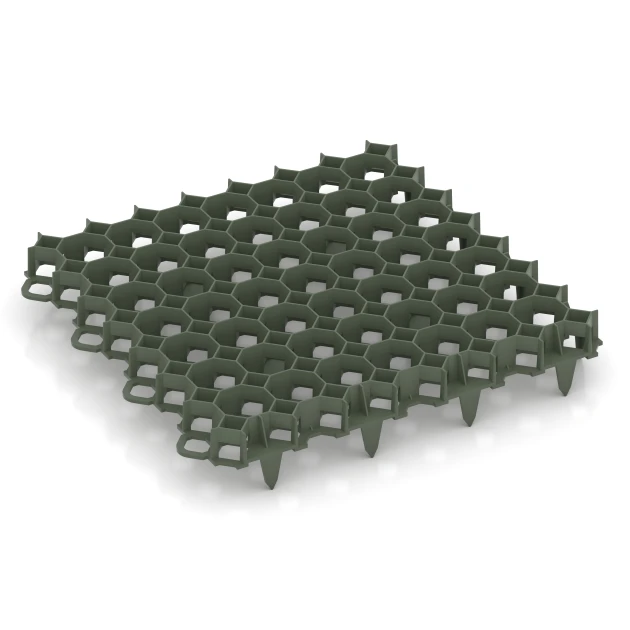
Plastic ground grid WG "Matte Green"
- /
-
Delivery in approx.
1-3 days - £14.16 / 4.42 Piece / m²
- (1.00 kg / Piece)
EAN: 4251469336346 | Item no.: 3634
Plastic ground grids are a versatile and economical solution for stabilising outdoor surfaces. They serve both as an ideal base layer for rubber flooring tiles and as an independent ground reinforcement system for paths, driveways or parking spaces – wherever a long-lasting, load-bearing surface is needed with minimal effort.
Depending on the intended use and expected load, the grids can be installed directly on natural ground, in a compacted gravel bed or over a frost protection layer. The subsequent finish depends on the desired application:
– The grids can be half-filled with soil or substrate and sown with grass, creating a reinforced but natural-looking green surface.
– They can be completely filled with gravel or chippings to create walkways, driveable areas or a base for rubber tiles.
– The surface can be overfilled by approx. 2 cm with decorative gravel, creating a stable and visually appealing gravel driveway or patio.
Installation is straightforward and requires no machinery. Often, it’s sufficient to remove the topsoil, level the base, and embed the grid into a gravel layer. This keeps excavation, material use and labour to a minimum – while still delivering high stability and durability.
WARCO recommends plastic ground grids as a base layer on unbound subsoil – especially where a path, terrace, playground or similar area is to be created on a meadow or natural surface. The result is a solid, permeable and unsealed surface – allowing rainwater to drain naturally into the ground.
The grid features integrated ground spikes approx. 4 cm in length that actively anchor it into the sub-base. On two sides, interlocking pins engage with matching sockets on neighbouring units to form a secure, load-stable grid system. Once filled with gravel, the surface can withstand loads of up to 400 t/m².
Each unit is made from a single-type plastic regranulate based on PE and PP production offcuts. The material is free from harmful substances, frost-resistant and fully recyclable. Combining both plastics ensures excellent mechanical strength and long service life.



Discount
Product Highlights
Product Details – Material and Structure
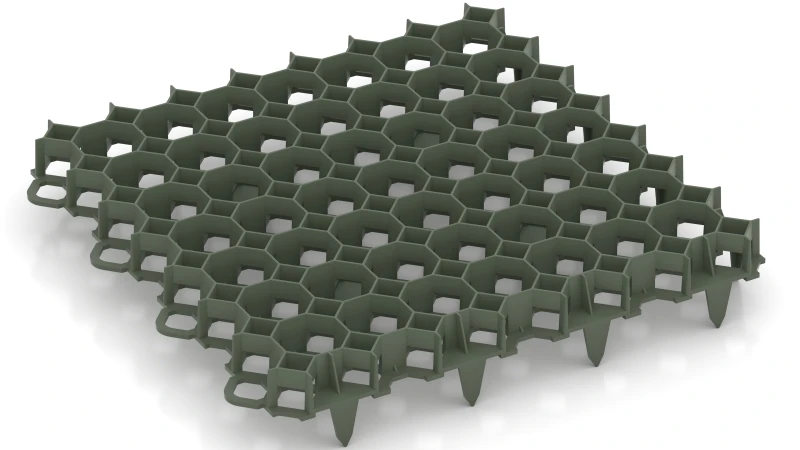

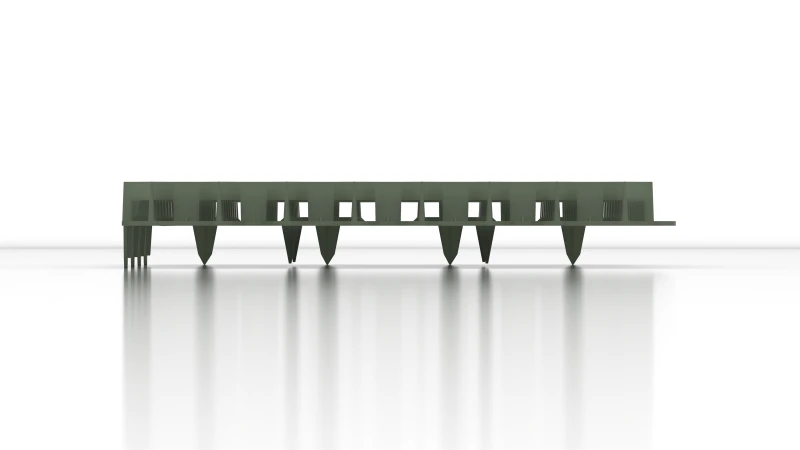
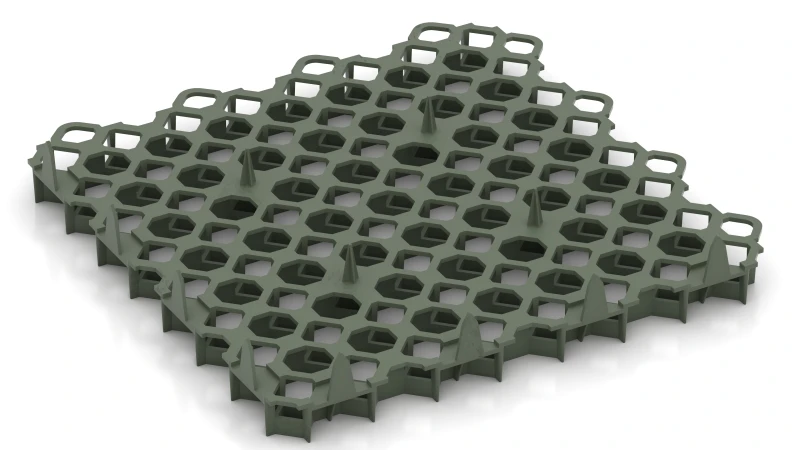
Patio tiles must be installed on a suitable sub-floor to ensure long-term stability and safety. The choice of substrate will depend on the type of decking being used. For tiled decks, a concrete slab is generally required, over which a sloping screed is laid to facilitate proper drainage; the tiles are then glued and grouted.
However, there are variations that do not require a concrete base. For example, rubber granules, wood tiles or thick slabs of concrete or natural stone can be laid on a base of plastic grass grid. This method requires minimal earthwork and offers the advantage of permanent water permeability. When planning your patio, choose the most suitable surface first and then create the appropriate sub-base, avoiding concrete wherever possible.
Whenever rubber playground tiles or terrace slabs made of rubber granulate are to be permanently installed on natural or filled ground – for example, on a lawn, in a park, on a playground, or in an equestrian arena – using grass grids or gravel grids made from recycled plastic provides the most optimal and cost-effective base.
Grass grids or gravel grids used as a support layer offer only advantages compared to a conventional bedding of gravel (sand or small stones):
- In many cases, an additional sub-base of crushed stone can be omitted.
- The earthworks are often significantly reduced, with much less excavation required.
- Mechanical compaction is usually unnecessary.
- Generally, no slope or drainage is needed, as the entire surface is permeable.
- Playground safety mats or terrace slabs lie much better without the risk of depressions forming.
For any type of surface, including rubber granulate tiles, the supporting layer must be capable of permanently carrying the loads generated during use without deforming or settling. It is evident that the load on a terrace is lower than on a driveway.
In addition to the expected surface load, the nature and composition of the underlying soil play an important role. Less stable soils (for example, loose or cohesive soils) require a more robust support layer than stable soils with a low fine-grain content.
The appropriate construction of the support layer beneath the slab surface always depends on the local conditions. When using grass grids or gravel grids, three installation methods are possible:
A – Direct installation on the prepared ground:
In particularly good soil conditions and with low surface loads, it is sufficient to remove the topsoil (4 cm for the grid plus the height of the rubber tiles), carefully level the area, lay the grass or gravel grid on the leveled surface, and fill it up to the top edge with paving gravel or similar material. The tiles are then laid on top of the grid.
B – Installation in a gravel bed without an additional support layer:
Under good soil conditions and with low to moderate surface loads, it is sufficient to install the grid into a gravel bed. First, the topsoil is removed – 2–5 cm for the gravel layer plus 4 cm for the grid plus the height of the tile surface. The area is then carefully leveled. The crushed stone layer is compacted and smoothed on the levelled surface. The grid is laid on the gravel layer and filled up to the top edge, but not beyond, before the slabs are installed.
C – Installation on a gravel sub-base with a gravel topping:
In cases of unfavorable soil conditions, frost protection requirements, or high loads (e.g. vehicular traffic), a conventional sub-base of crushed stone should be installed. The thickness of the crushed stone layer after machine compaction is 10 to 40 cm, depending on the local conditions. During excavation, the following layer thicknesses must be considered: 10–40 cm of crushed stone, 3–5 cm of gravel, 4 cm for the grid, and the tile surface on top.
After excavation, the area is leveled, the crushed stone sub-base is carefully installed and mechanically well compacted, and a 4–6 cm layer of gravel is applied. The grid is then laid on the gravel bed and filled up to the top edge, but not beyond, before the surface is installed.
The major advantages of using grass grids or gravel grids are:
- A load-stable and firm support capable of handling up to 400 t/m².
- The entire surface is highly permeable and facilitates water infiltration.
- The gravel remains securely in the grid, preventing displacement or floating.
- Playground safety mats or terrace slabs remain level and secure for many years without the risk of depression formation.
Recycled plastic grass grids and gravel grid panels offer a cost-effective alternative to the traditional crushed stone base for playground safety mats or rubber granulate terrace slabs:
- In many cases, an extra crushed stone layer can be omitted.
- Earthworks are significantly reduced with much less excavation required.
- Mechanical compaction is often unnecessary.
- A slope and drainage system are generally not needed because the entire surface is permeable.
- Safety mats or terrace slabs lie more evenly and without the risk of depression formation.
- The overall structure is more economical.
The optimal construction of the support layer always depends on local conditions. When using grass or gravel grids, three installation options are available:
A: Installation directly on the existing ground
B: Installation on split (gravel) only, without an additional crushed stone layer
C: Installation on a crushed stone sub-base with a gravel topping