
ALLESDICHT – Waterproofing Coating AD "Grey"
-
This product is currently unavailable.
/ - 0.30 Piece / m² x 2 mm
- (11.00 kg / Piece)
EAN: 4251469300309 | Item no.: 0030
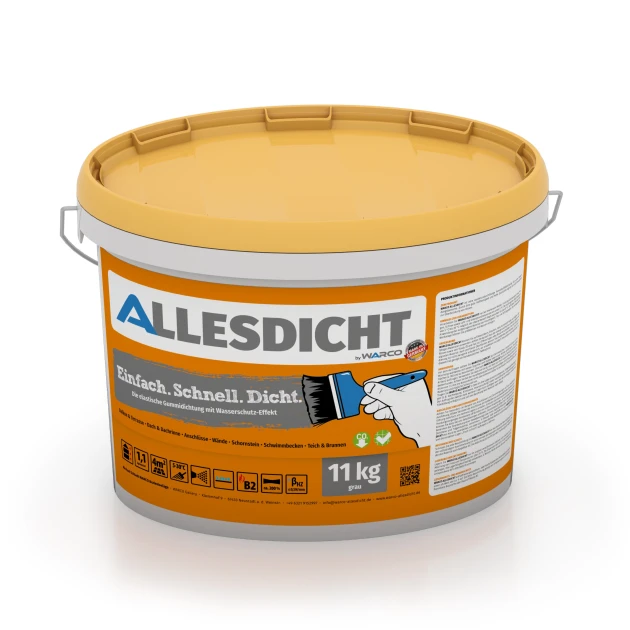
ALLESDICHT – Waterproofing Coating is a ready-to-use liquid membrane for reliable moisture protection in both interior and exterior applications. Applied directly from the tub using a brush, roller, trowel or airless spray system, it cures to form a seamless and elastic barrier. It offers long-term protection against rising damp and water ingress – ideal for both refurbishment and new construction.
Applications and compatible substrates
Typical areas of use include flat roofs, balconies, terraces, basement walls, floor slabs, junctions and pipe penetrations – especially in locations exposed to moisture. ALLESDICHT adheres strongly to concrete, bitumen, brick, wood, metal, fibre cement, ceramic tiles and well-adhered existing coatings – even on slightly damp substrates.
Simple and safe application
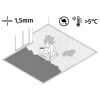
The coating has a smooth, honey-like consistency and is applied in 2 to 3 coats. Each wet layer should not exceed 1.5 mm; the final dry membrane should be 2–3 mm thick. Average consumption is approx. 3.3 kg/m². The product is solvent-free, water-dilutable, pH-neutral and non-irritant – suitable even for confined spaces. Application is recommended at ambient temperatures between +5 °C and +30 °C. In critical areas, a reinforcement mesh can be embedded between layers.
Certified quality and fire classification
ALLESDICHT is certified to DIN 18533 for use in structural waterproofing and meets fire classification B2 according to DIN 4102-1. It is suitable for contact with standing or pressurised water. Available in black, grey or red, in tubs of 3 kg, 11 kg or 25 kg.




Product Highlights
Characteristics
Product Details – Material and Structure


Comparative values
The number of tiles required for an irregular area can be calculated manually or determined using the digital laying planner.
For irregular areas, a scaled laying plan on graph paper is recommended. For the manual calculation method, draw the area on graph paper at a scale of 1:100, where 1 cm corresponds to 1 m. Place the tile grid over the drawing and draw the tiles within the area according to their laying dimensions. The drawing shows where offcuts will be required and allows the required number of tiles to be counted.
The online laying planner determines the quantity required more quickly than the manual calculation method. It is available for every product in the online shop. Once the area dimensions have been entered, the tool automatically calculates the number of tiles required and displays a suitable laying pattern. On the product page, simply click ‘Plan installation’. The planner works directly in the browser, is free of charge and does not require registration.
Waterproofing a terrace involves applying ALLESDICHT liquid-applied waterproofing beneath the terrace covering. The substrate must be sound and clean, while the terrace waterproofing protects the building structure below from penetrating water over the long term. Adequate falls must be provided to ensure water drainage.
ALLESDICHT is applied directly to the prepared substrate. Suitable substrates include concrete, screed, existing tiles and bitumen. It also provides seamless waterproofing at junctions with the house wall, door threshold and drains, which are often weak points in sheet waterproofing.
ALLESDICHT is applied in at least three coats. The test certificate requires a dry film thickness of at least 3 mm; where water exposure is greater, for example due to temporary ponding, a dry film thickness of 4 mm is required. The elastic waterproofing bridges cracks in the substrate up to 0.5 mm wide. Once fully cured, rubber slabs or tiles can be laid directly as the terrace covering, and a further coating can be applied directly.
Depending on the area, liquid rubber can be applied to a prepared substrate by painting, brushing, trowelling or spraying; spraying requires airless spray equipment. The liquid-applied waterproofing is ready to use and only needs to be stirred thoroughly before application. It adheres to almost all common construction substrates, including concrete, wood, bitumen, tiles and metal. The substrate must be sound, clean and dry, and free from dust, oil and grease; highly absorbent areas should first receive a deep-penetrating primer.
The liquid-applied waterproofing is applied in two or three coats, with each subsequent coat applied only after the previous one has fully dried. A wet coat must not exceed 1.5 mm, while the finished rubber membrane reaches a thickness of at least 2 to 3 mm. Additional fabric reinforcement is incorporated at junctions and penetrations. Once dry, the coating forms an elastic, waterproof rubber membrane with elongation of over 200 %, allowing it to accommodate movement in the substrate.
ALLESDICHT liquid-applied waterproofing is applied to the substrate in two, three or more coats, depending on the required coverage. For reliable waterproofing, the dry rubber film must be at least 2 to 3 mm thick.
To achieve this dry thickness, allowance must be made for the loss of about one third of the wet thickness during drying: a 1.5 mm wet coat dries to around 1 mm, so a total wet application of about 3.0 to 4.5 mm is required. Each wet coat must be no more than 1.5 mm thick, and ALLESDICHT is always applied wet-on-dry. The precise number of coats depends on building requirements, the substrate and ambient conditions; additional coats may be appropriate at junctions and penetrations.